 How-to
Is Matte Paint Hard to Keep Clean on a Sports Car?
Last Updated: November 16, 2026
Quick Summary
Matte paint is harder to keep clean than gloss because its textured clear coat traps contaminants and cannot be polished or waxed. Wash it by hand with pH-neutral shampoo and the two-bucket method, dry immediately, and protect it with matte-safe products or film.
- Skip automatic car washes entirely, since brushes and hot wax will wreck a satin finish in one pass.
- Never let soap or hard water dry on matte paint, because water spots etch into the texture.
- A matte-formulated ceramic coating makes contaminants release easier but does not stop stone chips.
- Matte paint protection film is the only option on the list that stops stone chips.
- Remove bug splatter and bird droppings the same day, blotting rather than scrubbing with a microfiber towel.
Table of Contents
- Why Matte Paint on a Sports Car Needs Its Own Playbook
- How to Wash a Matte Car Without Damaging the Finish
- Matte Car Paint Care Products: What to Use and What to Avoid
- Ceramic Coating for Matte Paint: What It Does and What It Cannot Do
- Matte Paint Protection Film: The Physical Barrier Option
- Matte PPF vs Ceramic Coating vs a Combined System
- A Seasonal Maintenance Schedule for Barrie Roads
- Book a Matte-Safe Protection Assessment
- Frequently Asked Questions
Why Matte Paint on a Sports Car Needs Its Own Playbook
Matte paint is a factory or aftermarket finish that uses a flattening agent in the clear coat to scatter light instead of reflecting it, making protection a different job from caring for a glossy car.
Gloss clear coat has a smooth top layer you can polish. Matte clear coat does not.
That is why matte paint on a sports car needs its own playbook.
How a Matte Clear Coat Differs From Gloss
A matte finish is not a different color. It is the same paint under a clear coat that dries with a microscopic rough texture, and that texture creates the soft sheen.
Three things follow from this:
- No polishing. Abrasives flatten the texture and leave a gloss spot.
- No wax. Traditional wax fills the texture and creates streaks and blotches.
- Staining sticks. Bird droppings, bug splatter, and tree sap etch into matte clear coat faster than into gloss.
Once you understand that the texture is the finish, every product decision gets easier. If a product smooths or fills the surface, it is wrong for your car.
Guide to automotive clear coat types and finishes
How to Wash a Matte Car Without Damaging the Finish
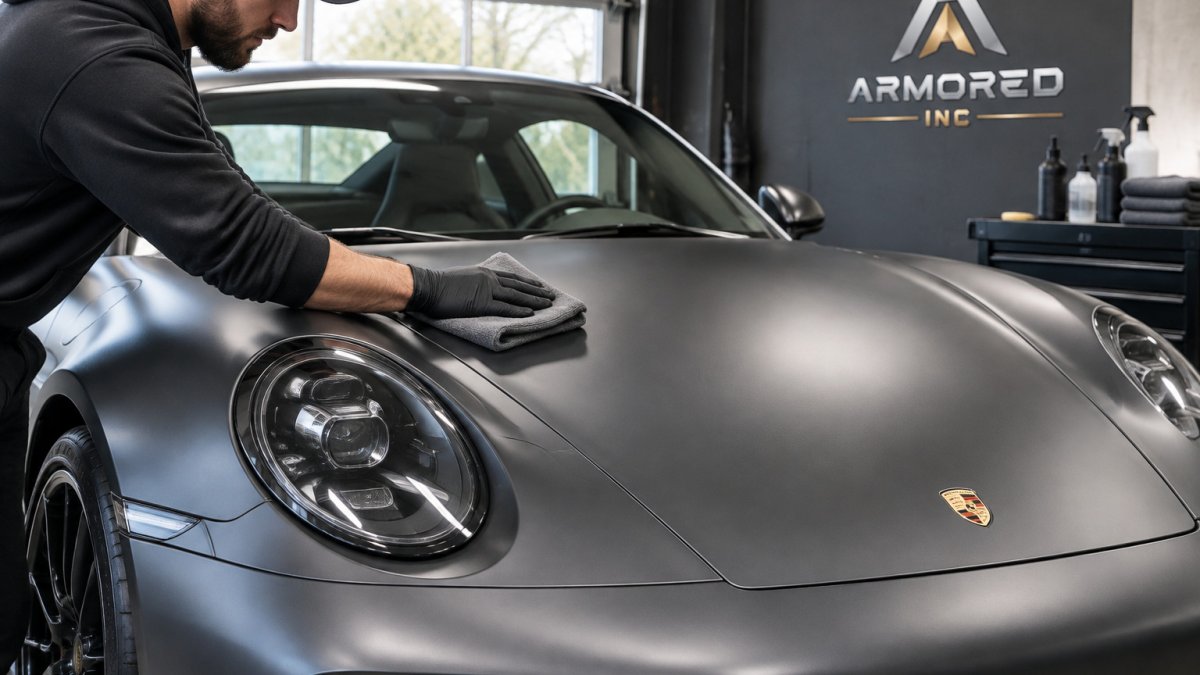
Washing a matte car safely means hand washing with a pH-neutral shampoo, a microfiber wash mitt, and the two-bucket method, then drying with a clean microfiber towel. Skip the automatic car wash entirely.
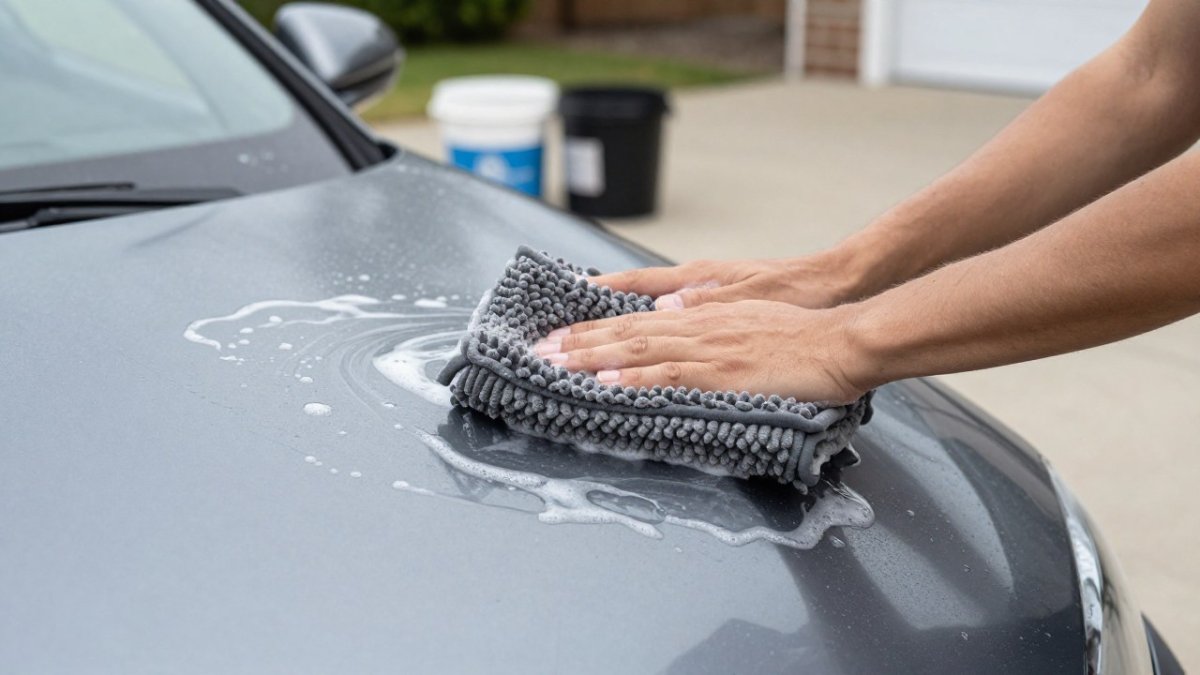
Here is the wash sequence we would use on any matte sports car:
- Rinse first. Knock off loose grit with plain water, top down.
- Wash one panel at a time. Use a pH-neutral shampoo and a clean microfiber mitt.
- Rinse the mitt in the second bucket before reloading with soap.
- Work top to bottom. Roof, hood, then sides, then the dirty lower panels last.
- Rinse the whole car before any soap dries.
- Dry immediately with a clean microfiber towel.
Never let soap or hard water dry on matte paint. Water spots etch into the texture and are hard to remove without abrasives.
The Two-Bucket Method and Safe Drying
The two-bucket method is simple: one bucket holds soapy water, the other clean rinse water. Dunk the mitt in the rinse bucket after every panel so grit drops to the bottom instead of going back onto the paint.
For drying, use a clean, dry microfiber towel and pat or drag it lightly.
Wash in the shade, and never on a hot panel.
Matte Car Paint Care Products: What to Use and What to Avoid
Matte car paint care products fall into two lists: what protects the texture, and what destroys it.
Use these:
- pH-neutral shampoo made for matte or coated finishes
- A soft microfiber wash mitt and separate microfiber drying towels
- A matte-specific cleaner for spot touch-ups
Avoid these:
- Polishing compound, scratch remover, or any abrasive
- Carnauba wax and most paste waxes
- Gloss-enhancing spray detailers
If a product promises "deep shine" or "wet look," it is not for your car. Matte products promise protection and UV resistance, not gloss.
Ceramic Coating for Matte Paint: What It Does and What It Cannot Do
A ceramic coating for matte paint adds a thin protective layer that makes cleaning easier and adds UV and chemical resistance. It does not add gloss when formulated for matte, and it does not make the surface scratch-proof.
What it does well:
- Makes bug splatter and bird droppings release with less scrubbing
- Adds a hydrophobic layer so water beads and runs off
- Helps block UV fade and road salt attack
What it cannot do:
- Stop stone chips
- Repair existing scratches or gloss spots
- Survive neglect
Surface preparation matters more on matte than on gloss: a coating locks in whatever is under it, so any contamination left on the paint stays there. We treat prep as the whole job, not a step before it.
How to Verify a Coating Is Actually Matte-Compatible
Labels are not always standardized, so verify before you buy or authorize an install. Look for explicit wording such as "matte-safe," "satin finish compatible," or "non-glossing" on the technical data sheet, not just the marketing front, and check whether it lists matte or satin clear coat as an approved substrate.
A safe test is to apply a small amount to an inconspicuous matte panel, such as inside a door jamb or under the hood, let it cure per the label, and compare sheen under the same light.
Choosing Between Matte PPF, Ceramic Coating, and a Combined System
The right answer depends on how the car is driven, which panels see impact, and how much maintenance you will actually do. Use this decision guide rather than treating the three options as interchangeable.
| Question | Ceramic coating only | Matte PPF only | PPF plus coating |
|---|---|---|---|
| Stops stone chips and road debris | No | Yes | Yes |
| Adds UV, chemical, and salt resistance | Yes | Some | Yes |
| Changes the satin appearance | No, if matte-formulated | No, if satin film matches | No |
| Best for | Garage-kept, light-use cars | Cars driven hard, on highways, or on track | Daily-driven sports cars |
| Maintenance burden | Low, but reapplication sooner | Low, film self-heals minor marks | Lowest, coating protects film |
| Removal and replacement | Reapplied periodically | Film removed and replaced | Film replaced, coating reapplied |
For a sports car, map the decision to panels rather than the whole car.
If the car sees Highway 400 or Highway 11 regularly, or sees track time, film first on the impact zones. For a full head-to-head breakdown, see our guide to ceramic coating vs paint protection film.
The combined system is what we recommend most often: film takes the impacts, coating goes on top to make washing easier and to protect the film from UV and contamination. For deeper matte-specific detail, our professional paint protection for matte cars guide covers it end to end.
Consumer guidance on vehicle coating claims and labelling
Matte Paint Protection Film: The Physical Barrier Option
Matte paint protection film is a clear urethane film with a satin top layer that goes over your paint and takes the hits instead of the clear coat. It is the only option on this list that stops stone chips.
Why it fits sports cars so well:
- The nose, hood, mirrors, and rockers take the most debris
- Film absorbs impact that would otherwise chip paint
- Matte film keeps the satin look consistent across the car
The trade-off is cost and installation skill. Film has to be cut and stretched precisely, and a poor install shows as lifted edges or trapped dirt.
Automotive paint protection film standards and testing
Matte PPF vs Ceramic Coating vs a Combined System
| Option | Stops Stone Chips | Adds UV and Chemical Protection | Changes the Finish | Best For |
|---|---|---|---|---|
| Ceramic coating only | No | Yes | No, if matte-formulated | Garage-kept cars, light use |
| Matte PPF only | Yes | Some | No, satin film matches | Cars driven hard or on highways |
| PPF plus coating | Yes | Yes | No | Daily-driven sports cars |
Our view: if the car sees Highway 400 or 11 regularly, film first. Coating alone is a good fit for a weekend car that stays covered. For a full head-to-head breakdown, see our guide to ceramic coating vs paint protection film.
The combined system is what we recommend most often. Film takes the impacts, coating goes on top of the film to make washing easier.
A Seasonal Maintenance Schedule for Barrie Roads
Barrie driving puts four distinct threats on your paint each year, and each interacts differently with a matte texture. Build your routine around them rather than treating maintenance as a single wash schedule.
Winter Salt, Sand, and Freeze-Thaw (December to February)
Barrie's winter road treatment is the hardest test for matte clear coat. Salt brine and sand lodge in the lower panels, wheel arches, and rocker panels, and freeze-thaw cycles drive moisture into seams. On a matte finish, dried brine leaves a chalky film that can etch if left for weeks.
- Rinse the underside and lower panels at a self-serve bay whenever the temperature is above roughly -5 C and the doors are not frozen shut. Avoid automatic brush washes entirely.
- Never chip ice or snow off the paint. Use a soft snow brush on glass only, and let the car warm up so ice releases on its own.
- After any significant salt exposure, do a full hand wash with pH-neutral shampoo rather than a touchless wash alone, since touchless chemistry can leave residue on matte film.
Spring Gravel and Salt Residue (March to May)
Spring is when winter damage becomes visible. Gravel on side roads and shoulders throws stones at low splitters and wide fenders, and residual salt activates again with spring rain.
- Book a full decontamination wash once the salt season ends, including the underside and wheel wells.
- Inspect the front bumper, hood leading edge, and rockers for new chips. On matte paint, a chip exposes a gloss or color layer and cannot be polished out, so it needs film or a matte-matched repair.
- Avoid following gravel trucks closely on Highway 400 and Highway 11 on your first spring drives.
Summer Bugs, Sap, and Sun (June to August)
Summer is the highest-risk season for staining because heat accelerates etching. Bug splatter and tree sap are acidic and bond to the matte texture faster than to gloss.
- Remove bug splatter and bird droppings the same day. Use a matte-specific cleaner and a soft microfiber towel, and blot rather than scrub.
- Park away from trees that drop sap, and wash sap off with a dedicated matte-safe tar and sap remover rather than solvent.
- If the car sits outside, a matte-safe spray sealant applied before summer reduces how aggressively contaminants bond.
Fall Prep Before the First Freeze (September to November)
Fall is the window to set the car up for winter. A fresh matte-safe sealant or coating top-up before the first freeze gives the surface a sacrificial layer through salt season.
- Apply a matte-compatible sealant or coating booster on a clean, dry surface in the shade.
- Check film and coating warranties before winter so any edge lift or defect is documented and corrected while conditions allow.
- Clear leaves from the cowl and drainage channels so trapped moisture does not sit against paint and film.
Emergency Response: Fresh Contaminants
Bird droppings, bug splatter, tree sap, fuel spills, and road salt should come off the same day with a matte-specific cleaner and a soft microfiber towel, blotting rather than scrubbing. For fuel spills at the filler neck, rinse with plain water and a pH-neutral shampoo, then dry immediately, since fuel can soften matte film if left.
If you are weighing film for a sports car, our best paint protection for sports cars breakdown is a useful next read.
Book a Matte-Safe Protection Assessment
Matte paint punishes guesswork. A product that works on gloss can leave a permanent gloss patch on a satin finish, and no polish will bring the texture back.
Armored Inc. works on paint protection film and ceramic coatings for vehicle owners in Barrie.
Before you commit, check our paint protection film pricing in Ontario guide and our complete Barrie PPF guide so you know what to expect.
Matte paint is not hard to keep clean. It is hard to keep clean by accident.
Frequently Asked Questions
Can you put paint protection film on matte paint?
Yes, provided the film itself is a matte or satin product. Standard gloss PPF will add shine and change the finish, so matte paint protection film is made with a textured top layer that matches the original sheen. Installation still requires proper surface preparation and a technician who has worked with matte clear coat before, because adhesive lift and edge trimming errors are far more visible on a non-reflective surface. Ask to see completed matte work before booking.
Can you wax or polish a matte-painted car?
No. Wax, polishing compound, and most glazes contain abrasives or fillers that flatten the texture of a matte clear coat and leave shiny patches that cannot be buffed out. Once a matte finish is polished, the only fix is repainting the panel. Stick to pH-neutral shampoo, a matte-specific cleaner, and a coating labeled for matte surfaces. If a stain will not lift with those, have a professional assess it rather than reaching for a compound.
What products should you avoid on matte car paint?
Avoid anything abrasive or gloss-enhancing: polishing compounds, cleaner waxes, carnauba wax, spray waxes, detail sprays with gloss enhancers, and automatic brush car washes. Skip harsh alkaline degreasers and bug tar removers with solvents that can stain the texture. Clay bars are risky on matte unless they are fine grade and used with plenty of lubrication. When in doubt, check that the label says matte-safe before it touches the paint.
Is ceramic coating or paint protection film better for matte paint?
They solve different problems. Ceramic coating for matte paint adds a thin, matte-compatible layer that makes washing easier and resists water spots and contamination, but it does not stop stone chips. Matte PPF absorbs impact from road debris and road salt spray, which matters on a low sports car. Many owners combine both: film on the high-impact panels and a matte-safe coating over the film and remaining paint. Ask a specialist which combination suits how you drive.