 How-to
How to Protect Boat Gel Coat From UV Damage
Last Updated: November 17, 2026
Quick Summary
Protect boat gel coat from UV damage by keeping a sacrificial layer of wax, sealant, or ceramic coating between the sun and the surface, and renew it before it fails. Wash every two to three weeks with pH-neutral soap, polish before waxing, and reapply protection mid-season on high-sun areas.
- UV light breaks down the resin matrix in gel coat through photo-oxidation, turning it porous and chalky.
- Polishing always comes before waxing, since waxing over oxidation seals the damage in.
- Choose a marine-grade product with UV inhibitors such as UV absorbers plus HALS for deeper protection.
- Store under a breathable cover, never a non-breathable tarp that traps moisture against the hull.
- Seal the hull at end of season before storage to keep winter moisture out of the pores.
Table of Contents
- Why Gel Coat Fails Under UV Exposure
- How to Prevent Gel Coat Oxidation Before It Starts
- Step-by-Step: Applying UV Protection to Gel Coat
- Choosing the Best Boat Wax for UV Protection
- Ceramic Coating for Boats: When It Beats Wax
- How to Restore Faded Boat Gelcoat
- Covers, Storage, and a Maintenance Schedule That Works
- Book a Marine Coating Assessment in Barrie
- Frequently Asked Questions
Why Gel Coat Fails Under UV Exposure
Gel coat is the pigmented resin layer on a fiberglass boat that gives it color and gloss. It is not paint, and it is not armor.
Hulls that left the marina glossy in June can come back chalky after a winter under snow and sun.
Damage can start before you notice it. Sunlight attacks the resin matrix in the gel coat and breaks its chemical bonds, photo-oxidation. Once the surface loses that resin, it can turn porous, letting in dirt, water, and more UV.
Understanding Gel Coat Porosity and Oxidation
Porosity is the small-scale roughness that develops as surface resin wears away. A porous surface holds water and contaminants and scatters light instead of reflecting it, so a neglected hull looks flat rather than wet.
Oxidation comes next: oxygen and UV degrade the resin, leaving a dull, chalky film. Wiping it off helps for a day, but it returns because the surface itself is breaking down, not just dirty.
Signs of Sun Damage: Yellowing and Chalking
Yellowing and chalking are the two clearest warnings that gel coat is losing the fight against UV. Yellowing shows first on white hulls and topsides as a warm tint that will not wash out; chalking is the fine powder that rubs off on your hand.
Other signs worth watching:
- Loss of gloss in patches, usually on horizontal surfaces
- Water that stops beading and starts sheeting
- Faint spiderweb cracks around fittings and cleats
- Dark streaks that return right after washing
Catch these early and a polish plus a protective layer usually restores the finish. Ignore them a few seasons and you are into restoration territory.
How to Prevent Gel Coat Oxidation Before It Starts
Prevention beats repair every time, and it costs far less. The core idea is simple: keep a sacrificial layer between the sun and the gel coat, and renew it before it fails.
A common mistake is treating protection as a once-a-season job, since summer sun can wear protection out faster than many owners expect.
Here is what actually works:
- Wash the hull every two to three weeks with a pH-neutral boat soap
- Remove surface contaminants before they bond to the gel coat
- Keep a wax or sealant layer on all horizontal surfaces, which take the most sun
- Store under a breathable cover, not a tarp that traps moisture
- Touch up the protective layer mid-season on high-exposure areas
Watch out: skipping the wash and waxing straight over dirt and old product traps grime under the new layer and speeds up oxidation.
Step-by-Step: Applying UV Protection to Gel Coat
Applying UV protection to gel coat is a four-stage job: clean, correct the surface, apply protection, and let it cure. Get the order right and results last; rush it and you will redo it in a month.
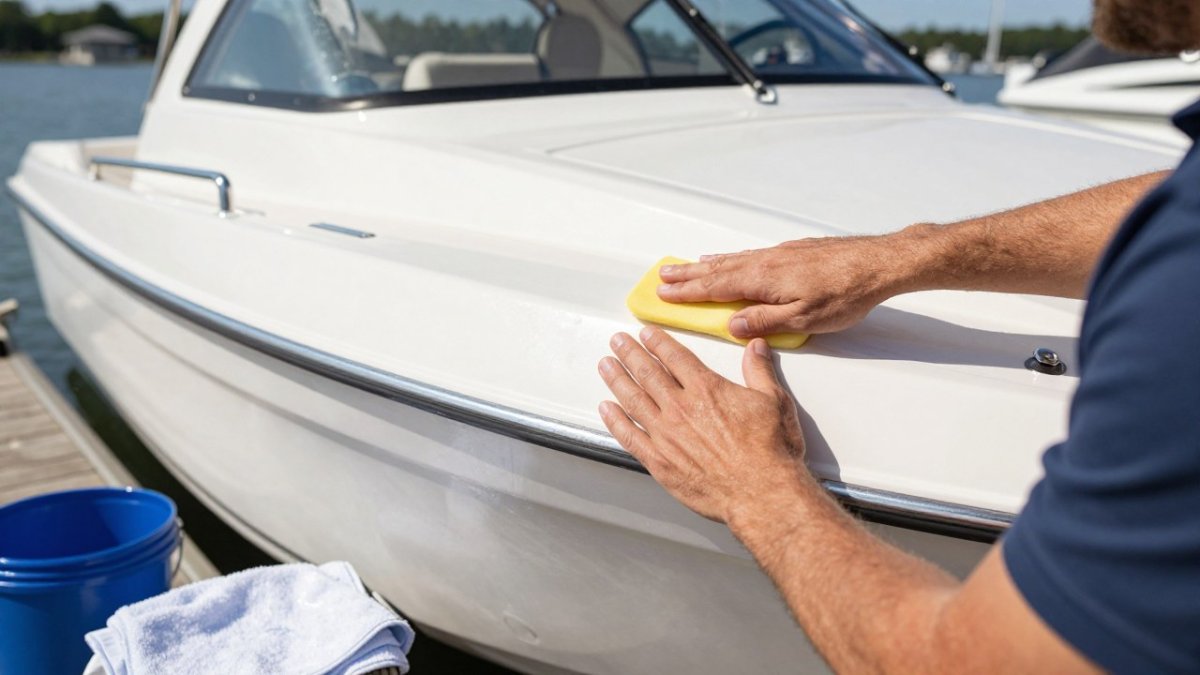
Cleaning and Surface Prep
Start with a cool surface in the shade, never a hull that has been baking in direct sun. Wash from the top down with a pH-neutral soap, then rinse thoroughly.
Next, remove bonded contaminants. A clay bar lifts grit that washing leaves behind, leaving a surface protection can bond to. Dry with a clean microfiber towel and check for leftover wax or polish residue.
Polishing vs. Waxing: What Comes First
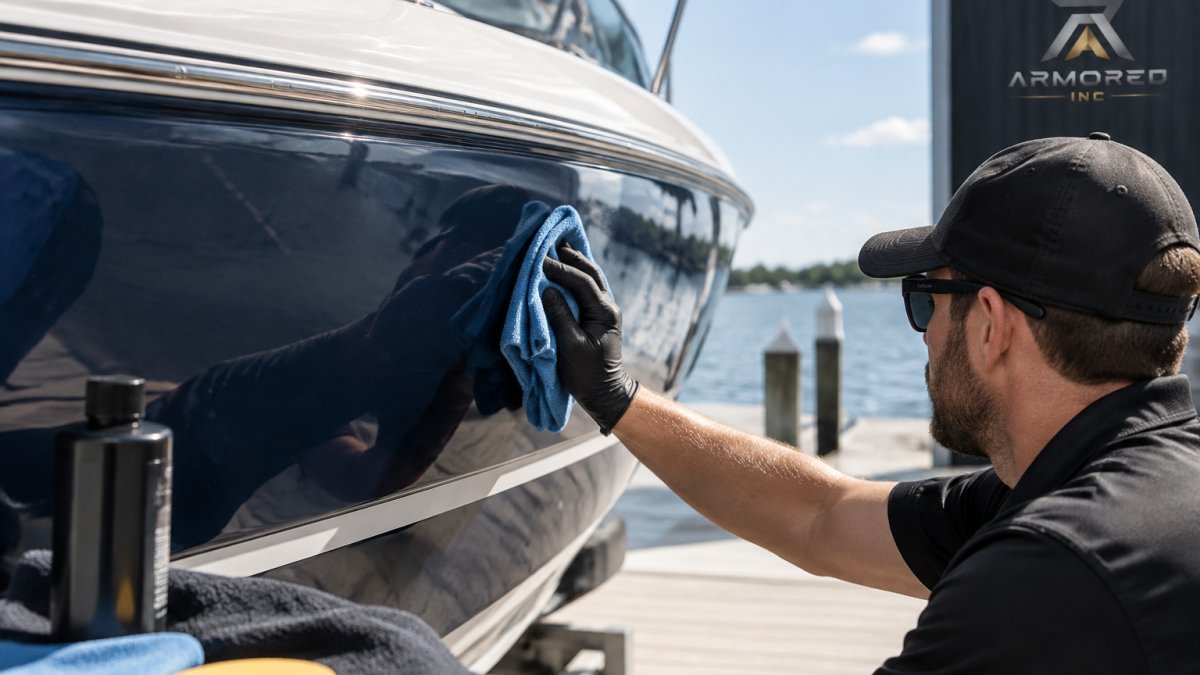
Polishing always comes before waxing. Polish is an abrasive that removes oxidized resin and restores gloss; wax is a protective layer on top. Waxing over oxidation seals the damage in.
The rule is simple:
- Clean and decontaminate the surface
- Polish to remove oxidation and bring back gloss
- Wipe off all polish residue
- Apply wax or sealant in thin, even coats
- Let it cure, then buff to a shine
For the full process, our guide on how to apply ceramic coating to a boat hull step by step walks through each stage in detail.
Choosing the Best Boat Wax for UV Protection
A marine-grade product with UV inhibitors is generally suited to boat gel coat, while car waxes are formulated for clear coat on metal panels.
UV inhibitors are the active ingredient that matters.
Your main options:
| Product Type | UV Protection | Durability | Best For |
|---|---|---|---|
| Carnauba wax | Moderate | Weeks | Quick seasonal touch-ups |
| Synthetic sealant | Good | Months | Most freshwater boats |
| Polymer sealant | High | Months | High-sun exposure areas |
| Ceramic coating | High | Long-term | Owners wanting low upkeep |
Carnauba wax gives a warm, deep shine but breaks down fast in heat and sun, and its natural resins offer limited UV absorption.
Chemical compatibility is a common source of problems. A few patterns are worth knowing before you buy:
- Wax over old wax: Layering a new synthetic sealant over a carnauba base often causes streaking and hazy patches, because the solvents cannot cut through the older film evenly. Strip the old layer with a prep spray or diluted isopropyl alcohol wipe before switching product families.
- Silicone-based products on gel coat: Some silicone-heavy dressings leave a film that subsequent polishes and coatings cannot bond to, forcing a full compound to remove. If you plan to ceramic-coat later, avoid silicone sealants now.
- Solvent strength vs. gel coat age: Older, porous gel coat absorbs solvent carriers more readily. A hot solvent wax on a chalky hull can lift pigment and leave blotches. On aged gel coat, start with a mild synthetic sealant and test a small area first.
- Ceramic over wax: A ceramic coating will not bond to a wax layer. Coating over wax is one of the most common DIY failures, usually showing up as patchy beading within weeks.
More product is not better. Thick coats can turn gummy and are harder to remove.
Match product to season and exposure. Boats kept in the sun or on a mooring usually need more frequent protection than trailered boats stored under cover.
Ceramic Coating for Boats: When It Beats Wax
Ceramic coating for boats can suit owners who want longer-lasting UV protection with less recurring work. A ceramic coating forms a chemical bond with the gel coat and leaves a hard, hydrophobic layer that resists UV, water spots, and surface contaminants.
Wax sits on top of the surface and wears away over time, while a ceramic coating bonds to the surface.
When ceramic is the better call:
- Your boat sits in the sun or on a mooring all season
- You are tired of waxing every three weeks
- You want easier washing and better gloss retention
- The gel coat is in good shape and worth locking in
When wax still makes sense:
- The gel coat needs correction first
- You are on a tight budget
- You enjoy the routine and want a seasonal ritual
For a deeper comparison, read our breakdown of the benefits of boat gelcoat ceramic coating and our honest take on whether professional boat ceramic coating is worth it.
How to Restore Faded Boat Gelcoat
Restoring faded gelcoat is a step up from polishing, and it can work if damage has not gone through the gel coat layer. If the surface is chalky and dull but not cracked through, you can bring it back.
The process:
- Wash and decontaminate the hull
- Start with a heavy-cut compound on a test patch
- Work in small sections with a dual-action polisher
- Step down to a finer polish to remove compounding marks
- Seal the restored surface immediately with wax or a coating
Sanding is only for serious cases and removes material you cannot put back, so try compounding first. If the gel coat is thin or cracks run deep, machine polishing will not fix it, that is when a professional assessment saves you money.
Use the least aggressive method that gets the result. That single habit preserves more gel coat than any product you can buy.
Covers, Storage, and a Maintenance Schedule That Works
Gel coat can be damaged across both summer UV exposure and winter freeze-thaw cycles.
Cover material choice drives the outcome:
- Breathable marine canvas or solution-dyed acrylic: Blocks UV, sheds snow, and lets vapor escape. The right default for outdoor storage in Barrie.
- Non-breathable polyethylene tarp: Cheap and UV-opaque, but it seals moisture in. Use it only as a temporary rain cover, never as a full-winter wrap directly against gel coat.
- Shrink wrap: Effective for snow and UV, but it must be vented. Unvented shrink wrap is a moisture trap, and the condensation it creates can be worse than leaving the boat uncovered under a roof.
Support matters as much as fabric. A sagging cover collects snow and water in pockets that press damp fabric against the gel coat for months.
Indoor storage is ideal.
A maintenance schedule keeps protection from quietly expiring:
| Frequency | Task |
|---|---|
| Every 2-3 weeks | Wash with pH-neutral soap |
| Monthly | Check beading, spot-treat dull areas |
| Mid-season | Reapply wax on high-sun surfaces |
| End of season | Full wash, dry, seal, cover before storage |
| Spring | Inspect for yellowing and chalking |
The end-of-season seal is the one most owners skip, and the one that pays off in Barrie.
Our article on marine ceramic coating for year-round boat protection explains how a coating fits into this schedule and cuts the recurring work.
Book a Marine Coating Assessment in Barrie
If your gel coat is already showing yellowing or chalk, guesswork gets expensive. A proper assessment tells you whether the surface needs polishing, restoration, or a coating, and it prevents you from waxing over damage that needs correction.
At Armored Inc., we offer ceramic coatings for boats and can discuss the right protection for your hull. For current options and pricing, contact us or visit our website.
Contact us to discuss whether a seasonal protective layer or a full coating suits your hull. If you are ready to stop watching the gloss fade, book a marine coating assessment in Barrie and get a clear plan for the season ahead.
Sun and water will always win a fair fight against unprotected gel coat. The fix is a proper protective layer, renewed on schedule, and applied to a surface that is actually ready for it.
Frequently Asked Questions
How do you protect boat gel coat from UV damage?
Apply a UV-stabilized marine wax or polymer sealant every three to four months, and keep the boat covered when stored. A ceramic coating for boats can add a harder, longer-lasting layer that resists photo-oxidation. Wash the hull regularly to remove contaminants that trap heat, and address chalking or yellowing early before the gel coat porosity deepens and restoration becomes a sanding job.
Does wax actually protect boat gel coat from UV rays?
Yes, but only partly and only for a few months. The best boat wax for UV protection contains UV inhibitors that slow photo-oxidation, yet carnauba-based waxes can break down faster under strong sun and repeated washing. Synthetic protectants and polymer sealants are generally more durable, and ceramic coatings are often used for longer-lasting protection. Reapply before the surface stops beading water, which is your cue the protective layer is gone.
How often should you wax or seal a boat's gel coat?
Reapply protection regularly during the boating season, following the product manufacturer's guidance. Boats kept in the water or exposed to full sun need more frequent attention than trailered boats stored under cover. Check the surface monthly: if water stops beading into tight droplets, the protective layer has worn through and it is time to reapply before oxidation sets in.
Can ceramic coating for boats prevent gel coat oxidation?
A ceramic coating can help slow oxidation by forming a chemical bond with the gel coat that resists UV exposure and repels water and contaminants. It does not make the hull maintenance-free.