 ultimate-guide
Benefits of Boat Gelcoat Ceramic Coating: 2026 Guide
Table of Contents
- Why Boat Gelcoat Needs More Than Wax
- Ceramic Coating vs Wax for Boats: What Actually Lasts
- How Boat Gelcoat Ceramic Coating Prevents Oxidation
- Marine Ceramic Coating Durability in Ontario Conditions
- Hydrophobic Properties: Water Beading and Easier Cleaning
- DIY vs Professional Application: What Can Go Wrong
- Maintenance Schedule for the Ontario Boating Season
- Frequently Asked Questions
Last Updated: September 15, 2026
Why Boat Gelcoat Needs More Than Wax
Gelcoat is the pigmented resin layer that gives a fiberglass hull its color and shine, and it is the surface most exposed to everything a lake throws at it. In Barrie, that means intense summer UV, spring acid rain, and a long winter layup. Standard marine wax sits on top of that surface for weeks, not seasons (boats.com).
This guide from Armored Inc. breaks down the benefits of boat gelcoat ceramic coating for Ontario boat owners, from oxidation prevention to easier spring cleanup.
Most owners discover the problem the same way: they pull the cover off in May and the hull that looked glossy in September is chalky and dull. That chalk is oxidized gelcoat, and wax did not stop it. A wax layer breaks down under UV and repeated washing, so protection disappears exactly when the season gets hardest. Ceramic coating is a silica-based, marine-grade layer that bonds to the gelcoat itself rather than sitting on it. The difference in how long each one lasts is the entire argument.
Ceramic Coating vs Wax for Boats: What Actually Lasts
Ceramic coating is a liquid polymer that chemically bonds to gelcoat and cures into a semi-permanent layer, while wax is a sacrificial coating that washes and wears away (pubmed.ncbi.nlm.nih.gov). That single difference explains the durability gap between them.
| Factor | Marine Wax | Ceramic Coating |
|---|---|---|
| Bonding | Sits on surface | Bonds to gelcoat |
| Typical lifespan | Weeks to a few months | Multiple seasons |
| UV resistance | Low | High |
| Hydrophobic effect | Moderate, fades fast | Strong, lasts |
| Cleaning effort | Frequent re-waxing | Rinse and wipe |
| Surface prep needed | Minimal | Full decontamination |
Wax still has a place. If you want a quick shine before a weekend on Lake Simcoe and you enjoy the ritual, wax does the job. What it cannot do is prevent oxidation over a full Ontario season.
How Boat Gelcoat Ceramic Coating Prevents Oxidation
Oxidation is the breakdown of gelcoat resin caused by UV exposure and airborne contaminants, and it shows up as fading, chalkiness, and loss of gloss (pubmed.ncbi.nlm.nih.gov). Ceramic coating interrupts that process by forming a UV-resistant barrier over the surface.
The barrier matters because Ontario summers deliver strong UV and spring brings acid rain that etches unprotected gelcoat. Nano-ceramic coatings also raise surface tension, so water, salt spray, and contaminants struggle to cling to the hull. Fewer contaminants sitting on the surface means less chemical attack on the resin underneath.
A common mistake is coating over oxidized gelcoat without paint correction first. If the surface is already chalky, the coating locks in the dullness instead of restoring gloss. Prep work, including buffing and polishing, is what makes the coating perform.
Marine Ceramic Coating Durability in Ontario Conditions
Durability depends on three things: prep quality, product grade, and how the boat is stored through the Ontario off-season. A coating applied to properly corrected gelcoat holds up through a full Ontario boating season and into the next, while a rushed application on a dirty surface can fail within months. That gap is not marketing, it is chemistry. A coating bonds to clean, corrected gelcoat; it cannot bond to oxidation, old wax residue, or embedded contamination.
Our climate is the real test, and it is worth being specific about why. Ontario's freeze-thaw cycles are the stressor most generic marine guides ignore. Water that finds its way into microscopic pores or under a compromised coating expands when it freezes, then contracts when it thaws. Repeated through a Barrie winter, that cycle can lift a poorly bonded coating and leave it flaking by spring launch. Coatings that survive a Muskoka or Georgian Bay season typically need only a maintenance wash and an occasional boost to keep performing. Coatings applied without surface preparation rarely make it that far.
Storage type changes the durability math:
- Indoor heated storage: The gentlest option. Stable temperature, no freeze-thaw cycling on the hull, and the coating typically reaches the upper end of its rated life.
- Indoor unheated storage: Still protected from UV and precipitation, but the hull still experiences freeze-thaw swings. Coatings in good condition handle this well.
- Outdoor shrink-wrapped storage: The most common Ontario setup. Shrink wrap protects against precipitation and UV, but condensation can form underneath. Ventilation matters, and a coating boost before wrap-up pays off.
- Left in the water year-round: The hardest on any coating. Constant immersion, ice movement, and continuous contaminant exposure mean more frequent inspection and maintenance.
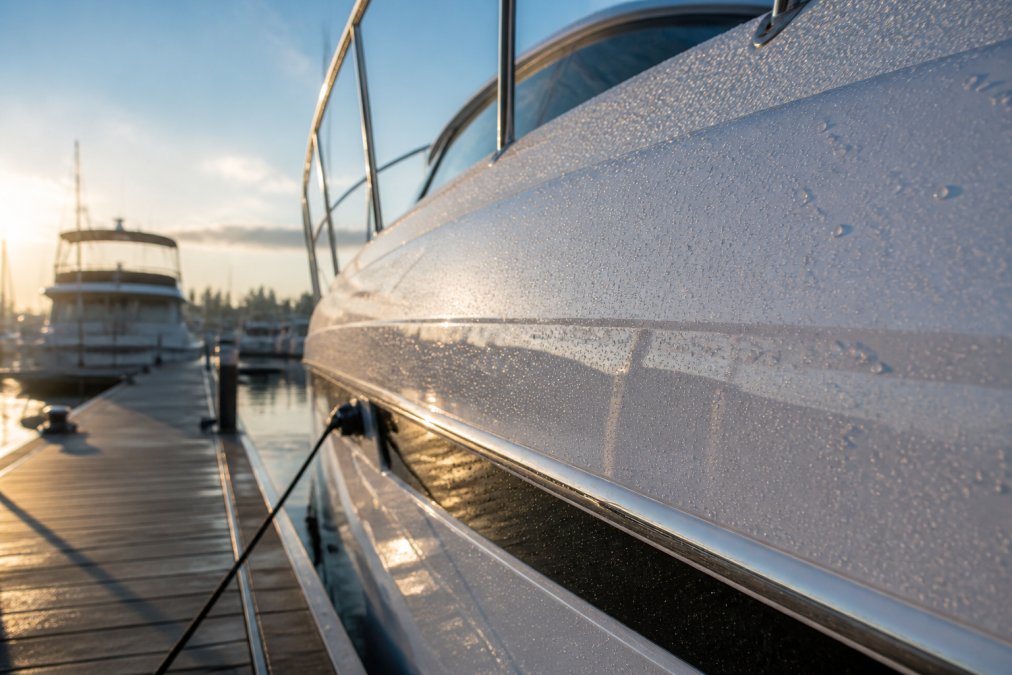
A reasonable expectation for a professionally applied, properly prepped marine ceramic coating in Ontario is two to three boating seasons of solid performance with routine maintenance, and longer with indoor storage. The coating does not fail all at once, it degrades gradually, and the beading test tells you where it stands. When water stops beading across the hull, it is time for a decontamination wash and a maintenance boost, not a full reapplication. Mastering these simple upkeep cycles preserves the integrity of your finish and serves as a foundational skill for broader DIY boat maintenance.
Hydrophobic Properties: Water Beading and Easier Cleaning
Hydrophobic means the coating repels water, so instead of spreading across the gelcoat, water forms tight beads and rolls off. That beading behavior is the clearest sign a coating is still working.
The practical payoff is cleaning. Water spots, lake scum, and bird droppings release with a rinse and a light wipe rather than scrubbing. Stain resistance improves too, because contaminants cannot bond to the slick surface. For anyone who has spent a Saturday fighting water spots on a white hull, this is the benefit that sells the coating.
DIY vs Professional Application: What Can Go Wrong
DIY ceramic coating kits are widely available, and some owners get decent results. The risks are real, though: high spots, uneven coverage, and coating over contamination are the most common failures.
Professional application matters most when the gelcoat needs correction first. Buffing and polishing to remove oxidation takes the right compounds, pads, and machine control. Skipping that step, or applying in direct sun or high humidity, produces hazing and patchy gloss that is difficult to fix without stripping the coating.
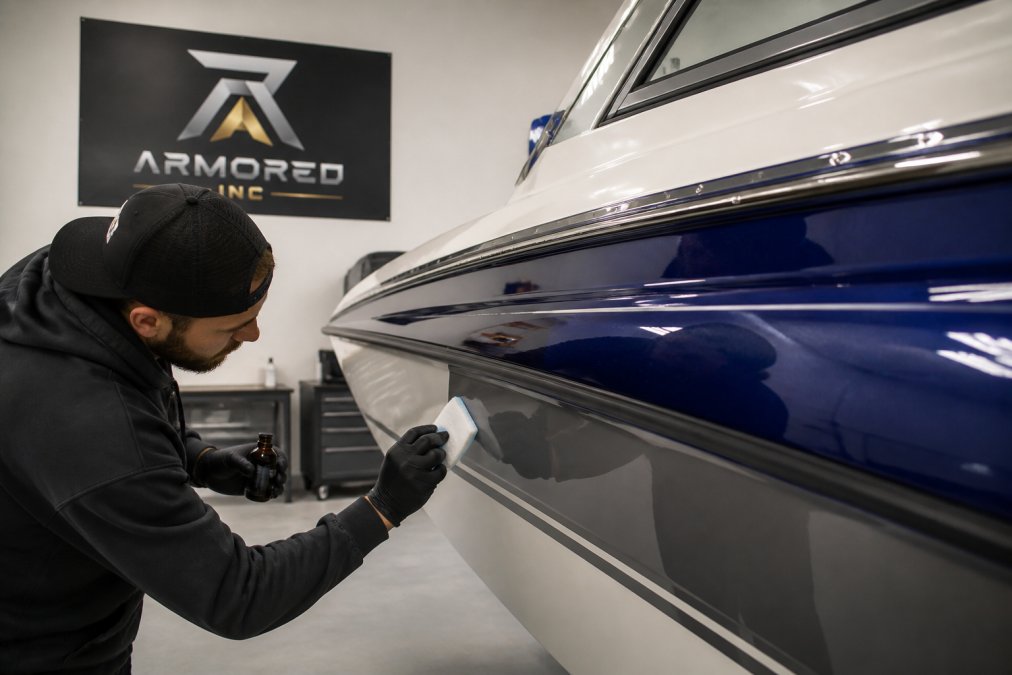
At Armored Inc., marine coating work starts with surface preparation and paint correction before any product touches the hull, and mobile service means the boat can be handled where it sits. If you are weighing the trade-off, the honest answer is that a careful DIY job on a clean, lightly used hull can work. A neglected or oxidized hull is where professional application pays for itself.
Maintenance Schedule for the Ontario Boating Season
A coating reduces maintenance, it does not eliminate it. The schedule below reflects how an Ontario season actually runs, from spring launch to fall haul-out.
- Spring launch: Decontamination wash, inspect for beading, apply a maintenance boost if needed.
- Every 2-4 weeks in season: Rinse after use, especially after salt or heavy lake scum exposure.
- Mid-season: Full wash with a pH-neutral marine soap, check high-wear areas like the waterline.
- Fall haul-out: Wash and dry before covering, apply a boost before winter storage.
- Winter: Keep the cover clean and ventilated to avoid trapped moisture against the gelcoat.
Boats stored in the water year-round need more frequent inspection, since constant immersion and contaminants work on the coating continuously. For owners searching for marine ceramic coating near me in Barrie, the maintenance routine is the same regardless of who applied it, and following it is what stretches durability across multiple seasons.
Protecting a hull from Ontario UV, acid rain, and freeze-thaw cycles takes more than a seasonal wax. Armored Inc. provides professional marine ceramic coating in Barrie, with full surface preparation, paint correction, and mobile service so your vessel is handled where it sits. Our ceramic coatings deliver lasting hydrophobicity and UV protection, and our team also handles paint protection film and window tinting for vehicles and vessels. Contact Armored Inc. to book your boat in before the season starts and keep your gelcoat looking pristine.
Frequently Asked Questions
Is ceramic coating on a boat worth it?
For boat owners in Ontario, ceramic coating protects gelcoat from UV damage, oxidation, and acid rain. It creates a hydrophobic surface that repels water and contaminants, reducing cleaning time. While the upfront cost is higher than wax, the durability means fewer reapplications each season. If your boat sits outside or in the water from May to October, the protection is worth considering.
How long do ceramic coatings last on a boat?
Marine ceramic coating durability depends on product quality, surface preparation, and exposure. A professional-grade coating can last two to three years on gelcoat, compared to a few months for wax. In Ontario, boats stored outdoors or kept in the water year-round face more UV and temperature swings, which can shorten lifespan. Regular maintenance washes help extend it.
Does ceramic coating actually bond to boat gelcoat?
Yes, ceramic coating bonds to gelcoat after proper surface preparation. The process removes oxidation, old wax, and contaminants so the silica-based coating can attach to the gelcoat. Without prep, bonding fails and the coating peels. Professional application includes decontamination, buffing, and polishing before the coating cures, ensuring a strong bond.
What are the downsides of ceramic coating for marine gelcoat?
Ceramic coating requires professional application for best results, which costs more than wax. If applied over oxidized or contaminated gelcoat, it can trap defects and peel. It also does not prevent physical damage like scratches or impacts. For boats in Ontario, improper curing or DIY kits can lead to uneven finish. Maintenance washes are still needed to keep the surface clean.