 blog
Which Window Film Best Enhances Privacy and UV Protection?
Last Updated: October 29, 2026
Quick Summary
Ceramic window film best enhances privacy and UV protection while reducing interior heat, because its nano-ceramic particles reject solar heat without darkening glass as much as dyed or metallic films. Quality films block most UV rays regardless of shade, and darker or reflective options add daytime privacy.
- Ceramic film rejects infrared heat while letting visible light through, unlike dyed film which mostly darkens.
- Clear UV film blocks most UV rays while staying nearly invisible, but offers little privacy or heat rejection.
- Privacy film works best in daylight; at night, lit interiors stay visible from outside.
- Compare TSER for heat and VLT for darkness and Ontario tint compliance, not shade alone.
- South- and west-facing windows take the heaviest solar exposure in Barrie and benefit most from heat-rejecting film.
Table of Contents
- Why Window Film Solves Heat, UV, and Privacy Together
- Ceramic Window Tint for Heat Reduction: How It Performs
- Clear UV Protection Film for Cars: Blocking Rays Without the Dark Look
- Automotive Window Film Privacy Options: Day, Night, and Lighting Trade-Offs
- Window Tint UV Protection for Car Interiors: Stopping Fade and Sun Damage
- Comparing Film Types: Privacy, UV Rejection, and Heat by the Numbers
- What Barrie Drivers and Homeowners Should Know Before Booking
- Getting a Window Film Quote for Your Vehicle or Property
- Frequently Asked Questions
Why Window Film Solves Heat, UV, and Privacy Together
Window film is a thin, multi-layer polyester sheet bonded to glass that reduces solar heat gain, blocks ultraviolet radiation, and limits outside visibility, all without replacing the window itself.
Most guides treat these as three different purchases. They aren't. Heat, UV damage, and privacy all come from the same source: sunlight passing through untreated glass. Deal with the glass, and you deal with all three at once.
Here's what that means in practice.
Ceramic Window Tint for Heat Reduction: How It Performs
Ceramic window tint is generally regarded as a strong performer for heat reduction because nano-ceramic particles in the film can reject solar heat without darkening the glass as much as older dyed or metallic films.
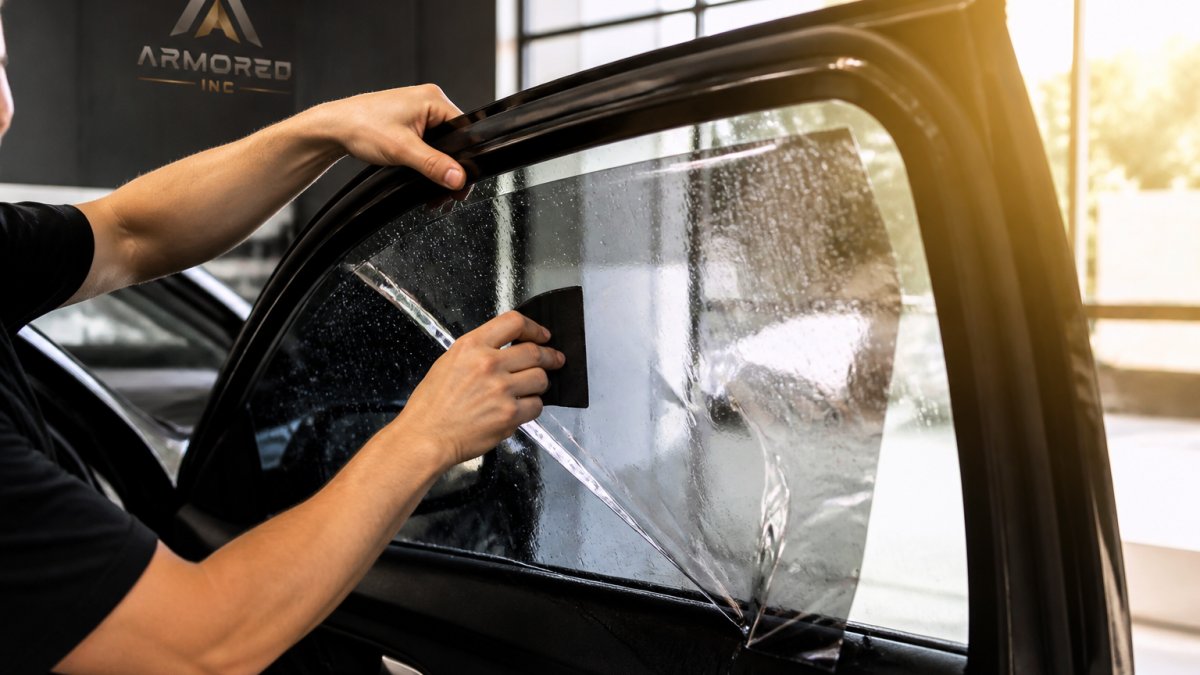
The reason matters. Ceramic film absorbs and reflects infrared energy, the part of sunlight that carries most of the heat, while letting visible light through.
For Barrie summers, that difference matters. For a deeper look at how ceramic tint performs on local vehicles, see our guide to ceramic window tint in Barrie.
Clear UV Protection Film for Cars: Blocking Rays Without the Dark Look
This is where a lot of buyers get confused. They assume tint has to be dark to work. It doesn't.
The trade-off: clear film does less for privacy and less for heat than a ceramic or darker film.
For a full breakdown of film types and what each one does, our guide to window tint types and installation covers the options in depth.
Automotive Window Film Privacy Options: Day, Night, and Lighting Trade-Offs
Automotive privacy film works best in daylight, when the bright exterior makes the darker interior hard to see into.
That's the honest answer most sellers skip. Privacy is not a constant. It depends on which side of the glass is brighter.
A few practical rules:
- Daytime privacy: a darker or reflective film blocks outside visibility well when the sun is out.
- Nighttime reality: if you're sitting in a lit cabin, people outside can see in. No film fully fixes this.
- Reflective film: strong daytime mirror effect, but it can look heavy and may draw attention from law enforcement if it's too dark or too reflective on certain windows.
Check the current Ontario rules on how dark tint can be on specific windows before choosing a shade. The point is to match the film to when you actually want privacy, not to assume one shade solves every lighting condition.
Window Tint UV Protection for Car Interiors: Stopping Fade and Sun Damage
Window tint UV protection is what saves your car's interior from the slow damage of sun exposure: faded upholstery, cracked dashboards, and dried-out trim.
What most people miss is that UV damage happens even on cloudy days and through side windows, not just the windshield. A car that sits outside daily takes a steady dose.
The fix is straightforward:
- Apply UV-blocking film to side and rear windows, where a lot of the damage originates.
- Choose a film with strong UV rejection, which most quality films offer regardless of shade.
- Pair it with interior protection for surfaces you touch and clean often.
Interior coatings can be paired with window film for this reason: film protects the glass, and a coating protects the surfaces behind it.
Comparing Film Types: Privacy, UV Rejection, and Heat by the Numbers
The right film depends on which of the three jobs matters most to you. But before you compare types, you need to know what the numbers on a spec sheet actually mean. Most sellers skip this step, which is why buyers end up choosing on shade alone.
The four metrics that matter
- UV rejection: The percentage of ultraviolet radiation the film blocks. Quality films are generally designed to reject a high share of UV up to 380 nm, the range most responsible for fading and skin damage. This figure is usually high across all film types, even clear ones.
- Total solar energy rejected (TSER): The share of overall solar energy (UV, visible light, and infrared) the film keeps out. This is the best single indicator of heat reduction. A higher TSER means a cooler interior.
- Visible light transmission (VLT): The percentage of visible light that passes through. Lower VLT means darker glass and more daytime privacy, but also less natural light. Ontario's tint rules for vehicles are written in VLT terms, so this number matters legally as well as visually.
- Infrared rejection: Often quoted as a single wavelength figure (for example, 95% at 1,000 nm). Treat single-wavelength claims with caution; they can look impressive without reflecting real-world heat performance. TSER is the more honest comparison.
How the main film types compare
| Film Type | Privacy (Day) | UV Rejection | Heat Reduction (TSER) | Visible Light | Best For |
|---|---|---|---|---|---|
| Dyed | Moderate | High | Low | Lower | Budget shade, light privacy |
| Metallic | Good | High | Moderate | Moderate | Heat and glare on a budget |
| Ceramic | Good | Very high | High | Higher for same shade | Hot cabins, clear performance |
| Clear UV | Low | Very high | Low | Very high | UV protection, factory look |
| Reflective | High (day) | Very high | High | Lower | Strong daytime privacy |
Read the table as a starting point, not gospel. Actual performance varies by product, and the labels here are relative to the other types, not a promise of a specific number. Ask for the film's published specs, including TSER and VLT, before you commit.
A simple decision framework
- If heat is the priority: Choose a ceramic or high-TSER film. Compare TSER figures across products rather than shade.
- If UV protection is the priority and you want a factory look: Choose a clear UV film with high UV rejection and high VLT.
- If daytime privacy is the priority: Choose a darker or reflective film, but confirm it meets Ontario's VLT limits on the windows you plan to cover.
- If you need a balance: A light ceramic film often gives the best mix of heat rejection, UV protection, and natural light, with moderate daytime privacy.
A common mistake is buying on shade alone. Darker doesn't automatically mean cooler or better protected. A light ceramic film can outperform a dark dyed one on heat while keeping more natural light. Ask for the film's verified specs alongside the price, and confirm the warranty terms in writing.
What Barrie Drivers and Homeowners Should Know Before Booking
Barrie's climate makes window film a year-round decision, not just a summer one. Long, bright summer days push interior heat and UV exposure, and winter sun still fades dashboards and furnishings through glass. But the local details matter more than most guides admit.
For drivers
- Ontario tint rules: Ontario sets limits on how dark tint can be on vehicle windows, and these rules are written in visible light transmission (VLT) terms. Confirm the current limits with the official Ontario source before choosing a shade, and check the film's VLT before you commit.
- Cold-weather curing: Film needs time to cure and adhere fully. In a cold Barrie winter, a heated shop and proper curing time matter more than in milder climates. Ask how the shop manages cold-weather installation, and follow the curing guidance you're given after application.
- Winter sun: UV exposure doesn't stop in winter. Snow cover reflects sunlight, and low-angle winter sun can still fade interiors. Film protects year-round, not just in July.
For homeowners
- Window orientation: South- and west-facing windows take the heaviest solar exposure in Barrie, so they benefit most from heat-rejecting film. East-facing windows get strong morning sun, and north-facing windows get less direct exposure but still transmit UV.
- Housing stock: Barrie has a mix of older homes with single-pane or early double-pane glass and newer builds with low-E coatings. Film compatibility varies with glazing type, so tell the installer what kind of glass you have. Film compatibility with certain glass types should be confirmed before installation.
- Seasonal performance: Film reduces summer heat gain, and in winter it can slightly reduce solar heat gain through south-facing glass. For most homeowners the summer comfort and UV protection outweigh the small winter trade-off, but it's worth discussing with your installer.
- Privacy at night: As with vehicles, residential privacy film works best in daylight. At night, interior lighting makes rooms visible from outside. If nighttime privacy matters, combine film with blinds or curtains.
Local service and booking
If you're weighing whether professional installation is worth it, our breakdown of whether professional window tinting is worth it walks through the cost-versus-value question honestly. To confirm your area is covered, contact us directly. When you book, ask about cold-weather curing, film compatibility with your glazing, and the warranty terms in writing.
Getting a Window Film Quote for Your Vehicle or Property
A quote should start with your goal, not a film name. Tell the installer whether heat, UV protection, or privacy matters most, and which windows you want covered. That drives the film recommendation.
Window film options can be discussed when you contact us, and we can review the film lineup with you before you book.
What to bring to a quote:
- Your vehicle or property details, including how many windows.
- Your priority: heat, UV, privacy, or a mix.
- Any legal limits that apply to your windows, so the shade stays compliant.
Pricing depends on film type, window count, and vehicle or property size, so contact us for a quote on your job.
Frequently Asked Questions
What is the best window film for reducing heat without darkening car windows?
A clear or lightly tinted ceramic film is the usual pick. Ceramic film uses nano-ceramic particles to reject solar heat and block UV rays while keeping visible light transmission high, so the glass stays close to its factory look. Ask for the film's total solar energy rejected and visible light transmission figures before you book, and confirm the shade falls within Ontario's tint rules for the windows you want covered.
Does clear window film block UV rays and protect a vehicle's interior?
Yes. Clear UV protection film for cars is built to reject the ultraviolet radiation that fades upholstery, cracks dashboards, and damages leather and trim, without adding noticeable darkness. Most quality films target high UV rejection, so the interior protection comes from the film's chemistry rather than its shade. That makes clear film a good fit for drivers who want sun damage protection but need to keep the factory glass look.
Which window tint offers privacy without making the windows very dark?
Privacy comes from contrast, not just darkness. A reflective or multi-layer film can limit outside visibility in daylight while staying lighter than a limo tint, and ceramic film adds heat rejection on top. At night or under bright interior lighting, any film becomes more see-through from outside, so plan for that trade-off. For homes, a dedicated privacy film or solar shade handles night-time visibility better than automotive tint.
How much heat can automotive window film reduce?
It depends on the film's total solar energy rejected figure, the window orientation, and the glazing. Ceramic and solar control films typically reject a meaningful share of solar heat gain, which lowers interior heat and takes pressure off the air conditioning. Ask for the manufacturer's published performance data rather than a verbal estimate, and remember that windshield, side, and rear glass each behave differently depending on angle and sun exposure through the day.
Window film only pays off when it's specified for your actual goal and installed so it lasts. That's the difference between a film that performs for years and one that peels in a season. Armored Inc. installs ceramic and UV-blocking window film for vehicles, marine vessels, and homes across Barrie, backed by mobile service, valet, and rental car options so your vehicle isn't tied up. Get started with Armored Inc. and protect your interior from heat and UV without sacrificing the view.