 blog
Stain Resistance Comparison: Marble vs Quartz Countertops
Table of Contents
- Marble vs Quartz Countertops: The Stain Resistance Comparison That Matters
- How Each Surface Is Built (and Why It Changes Spill Behavior)
- Porosity, Absorption, and What Actually Stains Each Surface
- Quartz Countertop Stain Resistance: What It Handles and What It Doesn't
- Marble Countertop Sealing: What a Sealer Can and Cannot Do
- Etching, Heat, and Everyday Wear: Where Quartz and Marble Diverge
- How to Remove Stains from Marble Countertops (and When to Call a Pro)
- How to Clean Quartz Countertops Without Damaging the Surface
- Which Surface Fits Your Kitchen? A Decision Guide for Barrie Homes
- Frequently Asked Questions
Last Updated: October 20, 2026
Marble vs Quartz Countertops: The Stain Resistance Comparison That Matters
Spilled red wine on a white marble island is the moment most homeowners start asking about a stain resistance comparison between marble and quartz countertops. Here is the short answer: quartz resists stains better because it is nonporous, while marble is porous and needs sealing plus fast cleanup. At Armored Inc., we protect countertops across Barrie, Ontario. Below, we break down exactly how each surface behaves, what actually causes damage, and how to choose.
How Each Surface Is Built (and Why It Changes Spill Behavior)
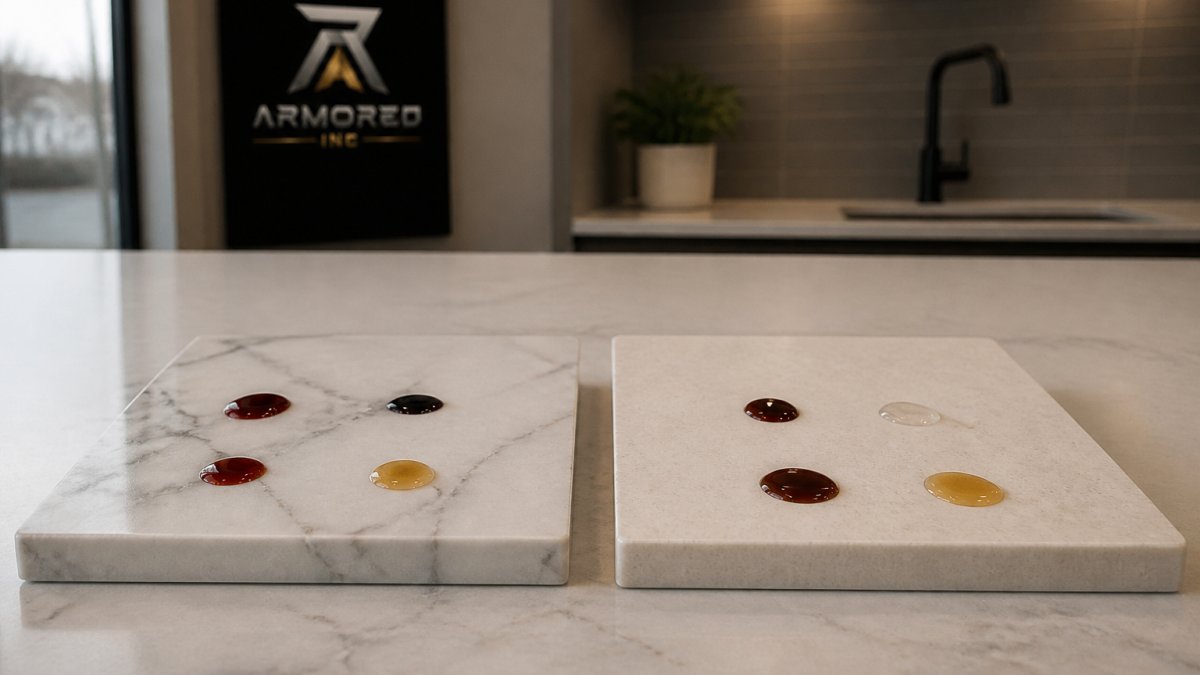
Engineered quartz is a manufactured slab: crushed quartz stone mixed with resin and pigments, pressed and cured into a dense, nonporous countertop. Marble is natural stone cut from a quarry, polished, and left with microscopic pores. That single difference in composition drives almost everything else in this comparison. Resin-filled quartz leaves liquids sitting on the surface. Natural marble lets them creep in.
Porosity, Absorption, and What Actually Stains Each Surface
Porosity is the measure of how much open space exists inside a material for liquid to fill. Engineered quartz has virtually none because the resin binder fills the gaps between crushed stone particles during manufacturing, so absorption is close to zero. Marble is natural stone with microscopic pores and fine fissures between calcite crystals, and those pores act like tiny capillaries. A spill does not just sit on marble, capillary action pulls it inward, and the longer it stays, the deeper it travels.
The practical consequence is a timeline. On sealed marble in a Barrie kitchen, a common pattern is that water-based spills like coffee or tea leave a surface mark within minutes and a deeper shadow within an hour if left alone. Oil-based spills, cooking oil, butter, cosmetics, sunscreen, are slower to absorb but harder to lift once they set, because they darken the stone from within. Red wine and tomato sauce combine pigment with acidity, so they can both stain and etch at the same time. On quartz, those same spills stay on the surface and wipe away clean.
It helps to separate two things homeowners often conflate:
- Staining is absorption of a colored or oily substance into the pores. It changes the color of the stone but not its texture. Marble stains; quartz effectively does not.
- Etching is a chemical reaction between acid and the calcium carbonate in marble. It leaves a dull, light-colored ring or mark on the polished surface and feels slightly rough to the touch. Etching is not a stain, and no sealer prevents it. Quartz does not etch because it contains no calcium carbonate.
A common mistake is wiping a spill with a wet rag and walking away. That pushes liquid into the pores and spreads it across a wider area. Blot, don't wipe, and act within minutes.
Product variation matters here too. A honed (matte) marble finish tends to show absorption and etching less dramatically than a high polish, but it can be slightly more prone to holding surface residue. Quartz formulations differ by manufacturer, and some slabs with higher resin content or a matte finish can show surface smudges more than a polished slab. Treat each material as a family of products, not a single uniform surface, and check the fabricator's care instructions for the specific slab you are considering.
Quartz Countertop Stain Resistance: What It Handles and What It Doesn't
Quartz countertop stain resistance is excellent for everyday kitchen and bathroom countertops. Because the surface is nonporous, wine, coffee, tomato sauce, and cooking oil wipe away clean with mild soap and warm water. In a busy Barrie household, hot drinks through the winter, red wine while entertaining, sunscreen and bug spray tracked in from the lake in summer, quartz is the surface that lets you wipe and forget.
What quartz does not handle well is heat and harsh chemicals. A hot pan set directly on the surface can scorch the resin, leaving a permanent dull or discolored patch that is not a stain but cannot be wiped away. Strong solvents, bleach, oven cleaner, and abrasive pads can dull the finish or damage the resin over time. Those are surface-damage issues rather than stains, but they matter just as much for long-term appearance.
A realistic spill-by-spill view for quartz:
- Red wine and coffee: wipe with a damp cloth and mild dish soap; no staining expected.
- Cooking oil and butter: wipe promptly; quartz does not absorb oil, though a film can linger if not rinsed.
- Tomato sauce and citrus: no etching risk on quartz, unlike marble; rinse and dry.
- Cosmetics, sunscreen, and bug spray: these can leave a surface film or, in the case of some solvent-based products, dull the finish if left on. Wipe promptly and rinse.
- Turmeric, food dye, and permanent marker: generally wipe clean, but a matte-finish quartz may hold residue slightly longer than a polished slab.
Response time still matters with quartz, but for a different reason than marble. You are not racing absorption; you are preventing residue from drying into a film or a solvent from sitting on the resin. A quick wipe is almost always enough.
For Barrie homeowners weighing quartz against marble, the practical takeaway is that quartz removes the sealing chore and the etching risk, but it does not make the countertop indestructible. Use trivets under hot pans, avoid harsh cleaners, and follow the manufacturer's care instructions for the specific slab, formulations vary, and a matte or textured finish may behave differently from a high-polish one.
| Surface | Stains Easily? | Needs Sealing? | Etches from Acid? | Best For |
|---|---|---|---|---|
| Engineered quartz | Rarely | No | No | Busy kitchens, rentals, low-maintenance homes |
| Sealed marble | Yes, if spills sit | Yes, periodically | Yes | Bathrooms, low-traffic counters, statement islands |
| Unsealed marble | Quickly | Yes, urgently | Yes | Not recommended for food prep |
Marble Countertop Sealing: What a Sealer Can and Cannot Do
Marble countertop sealing slows absorption; it does not waterproof the stone. A penetrating sealer fills some pores and buys you time to clean up, but it wears down with use and needs periodic sealing. It will not stop etching from acidic substances like lemon juice, vinegar, or wine. That is a chemical reaction with the calcium in the stone, and no sealer prevents it. Care instructions from stone suppliers are clear on this point, and the natural stone care guidance from Natural Stone Institute confirms that sealing reduces, rather than eliminates, staining risk.
Etching, Heat, and Everyday Wear: Where Quartz and Marble Diverge
Etching is a dull, light-colored mark left when acid eats into the polished surface of natural stone. Marble etches; quartz does not. Heat tells a similar story in reverse: quartz can scorch under a hot pot, while marble tolerates heat better. Scratch and chip resistance favors quartz in everyday use, though marble can be refinished by a professional. In practice, this means quartz wins on stain and acid resistance, and marble wins on heat tolerance and repairability.
How to Remove Stains from Marble Countertops (and When to Call a Pro)
Learning how to remove stains from marble countertops starts with identifying the stain type. Oil stains look dark; organic stains like coffee look brown or yellow. For surface stains, blot with a soft cloth and mild dish soap in warm water, then dry. For deeper oil stains, apply a poultice: a paste of baking soda and water, covered with plastic wrap and left overnight.
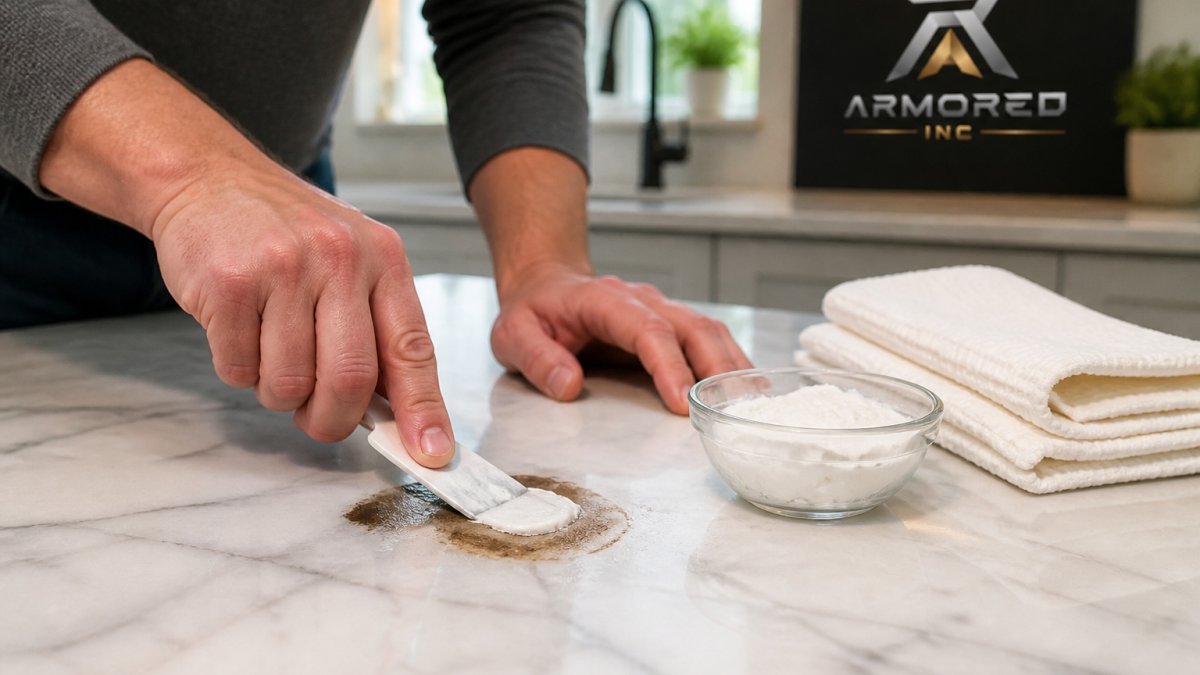
Call a professional when a stain has set for days, when the surface feels rough, or when etching has dulled the polish. Attempting to scrub or sand marble yourself usually makes it worse.
How to Clean Quartz Countertops Without Damaging the Surface
How to clean quartz countertops comes down to one rule: mild soap, warm water, soft cloth. Wipe daily, rinse, and dry. Avoid bleach, oven cleaner, and abrasive pads, which can dull the resin finish. For sticky residue, a plastic scraper works better than steel wool. Quartz needs no sealing, which is why many Barrie homeowners choose it for busy family kitchens and food preparation areas.
Which Surface Fits Your Kitchen? A Decision Guide for Barrie Homes
Barrie's winters mean plenty of hot drinks, red wine, and entertaining, and summer cottagers bring sandy gear and sunscreen indoors. If you want a countertop surface you can wipe and forget, choose quartz. If you love natural veining and will maintain it, choose marble in lower-traffic spots like bathroom countertops or a statement island.
- Choose quartz if: you cook daily, have kids, or want zero sealing.
- Choose marble if: you want natural stone character and will seal and clean promptly.
- Skip both for: outdoor kitchens, where freeze-thaw cycles stress any countertop.
Sealing, polishing, and protecting interior surfaces is part of what we do at Armored Inc. alongside our ceramic coatings and paint protection film work. If you are weighing options for your home near me in the Barrie area, our team can walk you through care instructions and surface protection that suits your household.
Frequently Asked Questions
Which is more stain-resistant, marble or quartz?
Quartz is more stain-resistant in everyday use. Engineered quartz is nonporous, so spilled liquids sit on the countertop surface instead of soaking in. Marble is a natural stone with open pores, and it needs periodic sealing to slow absorption of oil, wine, and coffee. Even a well-sealed marble countertop can still etch when acidic substances sit on it, because etching is surface damage rather than a stain. For households that want fewer maintenance steps, quartz wins on stain resistance.
Does marble need to be sealed to prevent stains?
Yes. Marble countertop sealing creates a temporary barrier that buys you time to wipe up spills before they absorb. Most marble countertops need resealing every six to twelve months, depending on use and the sealer. A sealer slows absorption, but it does not make marble waterproof, and it will not stop acidic substances like lemon juice or vinegar from etching the surface. Test your sealer with a small water droplet: if it darkens the stone instead of beading, it is time to reseal.
Can quartz countertops stain from common household spills?
Quartz countertop stain resistance is high because the surface is nonporous, but it is not stain-proof. Wine, turmeric, and oil-based sauces left sitting for hours can leave a mark, especially on lighter colors. The fix is prompt cleanup with mild soap and water. Avoid bleach-heavy wipes and harsh cleaners, which can dull the resin over time. If a mark persists, a soft cloth with a small amount of rubbing alcohol usually lifts it without harming the finish.
How should you clean a stain on a marble or quartz countertop?
For quartz, wipe the spill with mild dish soap and warm water, then dry the surface. For marble, blot the spill first and avoid acidic cleaners like vinegar, which etch the stone. For an oil stain on marble, a poultice made from baking soda and water drawn out over 24 to 48 hours often lifts the mark. If the stain is deep or the surface feels dull and rough, a stone restoration professional can re-polish and reseal the countertop.
Countertops take daily punishment, and the right protection makes them last. Armored Inc. offers interior coating solutions for residential and commercial properties, backed by the same surface-protection expertise we bring to ceramic coatings and paint protection film. Our mobile services and valet options make scheduling simple. Get started with Armored Inc. and keep your surfaces looking their best for years.