 blog
Alternatives to Traditional Car Wax for Commercial Vehicles
Last Updated: November 1, 2026
Quick Summary
Paint sealant and ceramic coating are the leading alternatives to traditional car wax for commercial vehicles, since wax breaks down in weeks under frequent washing and road salt. Sealant lasts several months and suits budget fleets, while ceramic coating lasts multiple years and resists detergents, salt and UV far better.
- Traditional carnauba car wax softens under heat, washes away with detergents and offers minimal road salt resistance.
- Paint sealant lasts several months and needs seasonal reapplication, making it best for budget and short-hold fleets.
- Ceramic coating lasts multiple years with maintenance and requires extensive prep including decontamination and paint correction.
- Paint protection film absorbs physical impact from rock chips, so combine it with coating on high-impact zones.
- Touchless car washes with pH-neutral soaps are the safest automated option for a coated fleet.
Table of Contents
- Why Traditional Car Wax Falls Short on Commercial Vehicles
- Paint Sealant vs Ceramic Coating for Fleet Paint Protection
- Ceramic Coating for Work Trucks: Durability and Wash Resistance
- Paint Protection Film for Fleet Vehicles: When Film Beats Liquid Coatings
- Ceramic Coating Maintenance for Work Trucks in Ontario Winters
- Touchless Car Washes, Road Salt, and Commercial Wash Compatibility
- DIY Application vs Professional Installation: Total Cost of Ownership
- Choosing the Right Protection for Your Fleet
- Frequently Asked Questions
Why Traditional Car Wax Falls Short on Commercial Vehicles
Traditional car wax made from carnauba wax or synthetic blends was never designed for the demands of a working fleet. On a commercial vehicle, wax breaks down in weeks, not months. That short lifespan is a core problem for commercial fleets operating in Ontario's demanding conditions.
The reason comes down to chemistry and workload. Natural carnauba wax softens under heat, washes away with detergents, and offers minimal resistance to road salt. A work truck that runs five days a week through Ontario winters will strip a wax layer fast. According to Transport Canada's vehicle care guidance, road salt and winter conditions are among the most damaging factors for vehicle exteriors.
Here is what makes wax a poor fit for fleet use:
- Low durability: Weeks of protection, not months, under frequent washing.
- High labor: Constant reapplication means vehicle downtime.
- Weak chemical resistance: Detergents and solvents strip wax quickly.
- Minimal UV and salt defense: Thin protection against Ontario's salt-heavy roads.
For a single weekend car, wax is fine. For a fleet, it is a recurring cost you never stop paying.
Paint Sealant vs Ceramic Coating for Fleet Paint Protection
Paint sealant and ceramic coating both outlast wax, but for a commercial fleet the decision is less about gloss and more about reapplication cadence, labor hours, vehicle downtime, and how each layer survives repeated washing. Paint sealant and ceramic coating differ in how long they last and how much preparation they need, and fleet managers should weigh those differences against their own routines.
The trade-off is straightforward. Sealant costs less per application and is more forgiving to apply, but it needs reapplication more often, which means more shop time and more vehicles out of service. Ceramic coating demands more surface preparation and a controlled curing window, yet it holds up far better to detergents, road salt, and UV exposure. For a fleet manager, the relevant question is not which product looks better on day one, but which one keeps vehicles on the road with the fewest touchpoints per year.
| Feature | Paint Sealant | Ceramic Coating |
|---|---|---|
| Typical lifespan | Several months | Multiple years (with maintenance) |
| Surface prep needed | Moderate (wash and decontaminate) | Extensive (decontamination, paint correction, IPA wipe) |
| Wash resistance | Good | Excellent |
| Salt and UV defense | Moderate | Strong |
| Reapplication frequency | Frequent (seasonal) | Rare (annual inspection recommended) |
| Downtime per service | Short | Longer initial install, then minimal |
| Best for | Budget fleets, short-hold vehicles, seasonal top-ups | Long-hold fleets, high-mileage trucks, vehicles washed frequently |
For fleet planning, the practical rule is: short-hold vehicles and tight budgets favor sealant with a disciplined seasonal schedule; long-hold, high-mileage, or frequently washed vehicles favor ceramic coating because it reduces the number of times each unit enters the shop.
Ceramic Coating for Work Trucks: Durability and Wash Resistance
Ceramic coating for work trucks delivers the durability that wax cannot. A ceramic coating is designed to create a hydrophobic layer that helps water bead and roll off the paint.
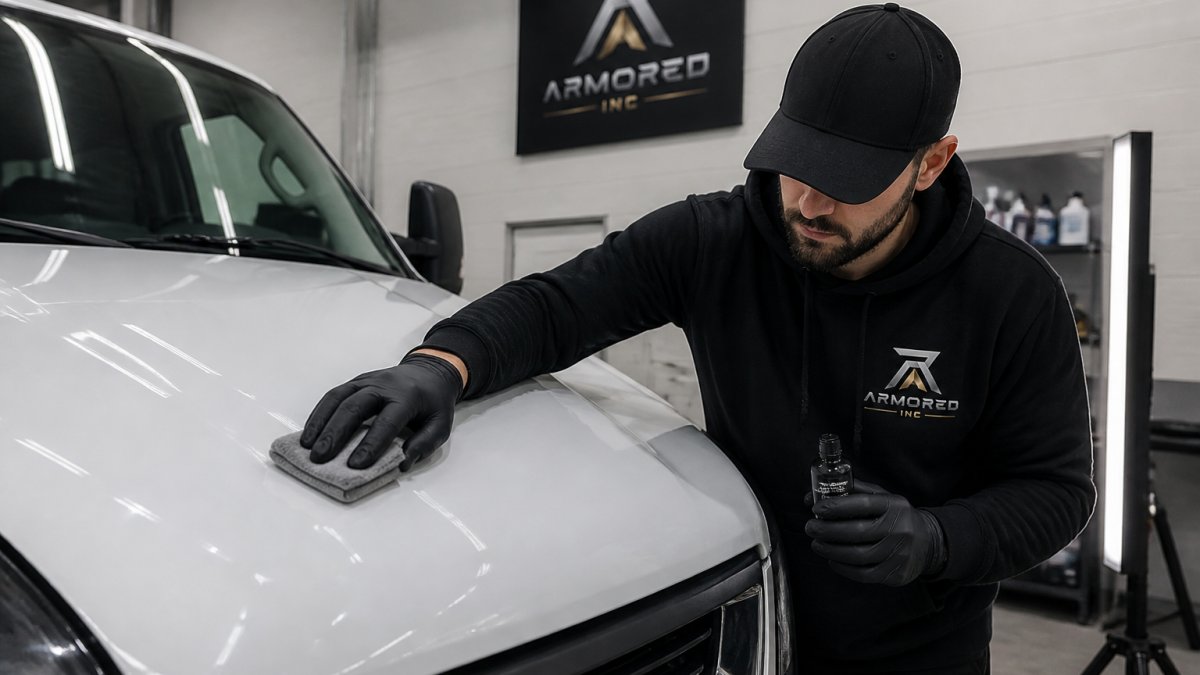
Surface preparation matters, since a coating can only perform as well as the paint underneath it. If the clear coat has swirls, contamination, or oxidation, the coating locks those flaws in.
Paint Protection Film for Fleet Vehicles: When Film Beats Liquid Coatings
Paint protection film for fleet vehicles wins when physical impact is the threat, not just chemicals. Ceramic coatings and sealants mainly address water, salt, and UV exposure, while paint protection film is designed to absorb physical impact from rock chips and road debris. For a direct comparison of which protects better, see film vs vinyl wrap.
Film makes sense for:
- Trucks that travel gravel or construction routes
- Vehicles with high-value paint or branding wraps
- Front-end and high-impact zones exposed to debris
- Fleets where repainting a panel is costly
Liquid coatings and film are not rivals. Many fleets combine them: film on impact zones, ceramic coating over the rest.
Ceramic Coating Maintenance for Work Trucks in Ontario Winters
Ceramic coating maintenance for work trucks in Ontario winters comes down to washing discipline and salt management. A coating reduces how often you need to wax, but it does not make a truck self-cleaning. Road salt still accumulates, and leaving it on the surface wears down any protection over time. Readers can follow a practical salt-protection walkthrough for commercial paint.
Winter conditions in Barrie bring salt, sand, and freeze-thaw cycles that test any protective layer. Regular washing helps remove salt buildup, and gentle cleaning methods are generally better for protected paint.
Touchless Car Washes, Road Salt, and Commercial Wash Compatibility
Touchless car washes are the safest automated option for a coated fleet, but even they require care. Touchless systems rely on high-pressure water and detergents rather than brushes, which avoids brush contact with the paint.
Frequent washing is important for commercial vehicles, since salt and grime should not be left on the paint for long. Matching the wash method to the protection helps:
- Touchless washes: Best for coated fleets; no brush contact.
- pH-neutral soaps: Protect the coating's hydrophobic layer.
- Avoid brush tunnels: Grit and bristles cause micro-scratches.
- Spot-free rinse: Prevents water spots and mineral deposits.
DIY Application vs Professional Installation: Total Cost of Ownership
DIY application looks cheaper on paper because the product price is visible and the labor is internal. For a commercial fleet, that comparison misses the costs that actually dominate: technician hours, vehicle downtime, rework, and the risk of a failed coating across multiple units. Total cost of ownership is the right lens, and it usually favors professional installation once you account for the full workflow. Before hiring, review these questions to ask a ceramic coating installer.
The takeaway for fleet managers: compare the fully loaded cost per vehicle per year, product, labor, downtime, and rework, not the sticker price of the bottle.
Choosing the Right Protection for Your Fleet
Choosing the right protection for your fleet starts with matching the product to the threat. Wax is out for commercial use. From there, the decision comes down to what your vehicles face every day.
Use this framework:
- Chemical and UV exposure only: Ceramic coating is the strongest liquid option.
- Rock chips and debris: Add paint protection film to high-impact zones.
- Mixed fleet: Combine film on impact areas with coating elsewhere.
- Budget constraint: Paint sealant offers a middle ground with more frequent reapplication.
At Armored Inc., we offer ceramic coatings and paint protection film, and we provide mobile service and valet options to keep your vehicles on the road. You can explore our ceramic coating service or learn about paint protection film for high-impact zones.
Frequently Asked Questions
Does wax really protect commercial vehicle paint?
Traditional car wax offers short-term protection, typically lasting a few weeks to a few months depending on conditions. On commercial vehicles that face daily washing, road salt, and UV exposure, that protection breaks down quickly. Carnauba wax and spray wax also attract dust and require frequent reapplication, which adds labor hours across a fleet.
Is ceramic coating better than wax for commercial vehicles?
For most fleets, yes. A ceramic coating is a protective layer applied to the paint. It generally costs more upfront than wax and requires proper surface preparation before application.
How long does ceramic coating last on a work truck?
Protection lifespan depends on the product, surface preparation, and how the truck is used. Protection lifespan depends on the product, surface preparation, and how the vehicle is used. Winter conditions, road salt, and frequent commercial washing shorten that window, so periodic inspections and a maintenance wash routine help you get the full life from the coating.
Can paint protection film be used on commercial vehicles?
Yes. Paint protection film is a clear film designed to absorb impact from stone chips and road debris. Film can be a useful option for vehicles that spend time on gravel roads or construction sites. Discuss coverage options with your installer based on your routes.
Your fleet's paint takes a beating every winter, and wax will not keep up. Armored Inc. provides professional ceramic coatings, paint protection film, and mobile service to protect commercial vehicles across Barrie and Ontario. Get started with Armored Inc. and keep your fleet protected through every season.