 how-to
What Happens If RV Paint Protection Film Peels
Table of Contents
- What Happens If RV Paint Protection Film Peels? The Immediate Risks
- Is It Normal for RV Paint Protection Film to Peel?
- How to Distinguish Peeling PPF from Clear-Coat or Paint Failure
- RV Paint Protection Film Peeling Repair: Your Options
- How to Remove PPF from an RV Without Damaging Paint
- RV Paint Protection Film Lifespan: What to Expect
- PPF Warranty for Peeling: What's Covered and What Isn't
- Conclusion
- Frequently Asked Questions
Last Updated: October 7, 2026
What Happens If RV Paint Protection Film Peels? The Immediate Risks
When RV paint protection film peels, the exposed paint loses its barrier against road debris, UV rays, and moisture, causing faster oxidation, stone chips, and water tracking under nearby film edges.
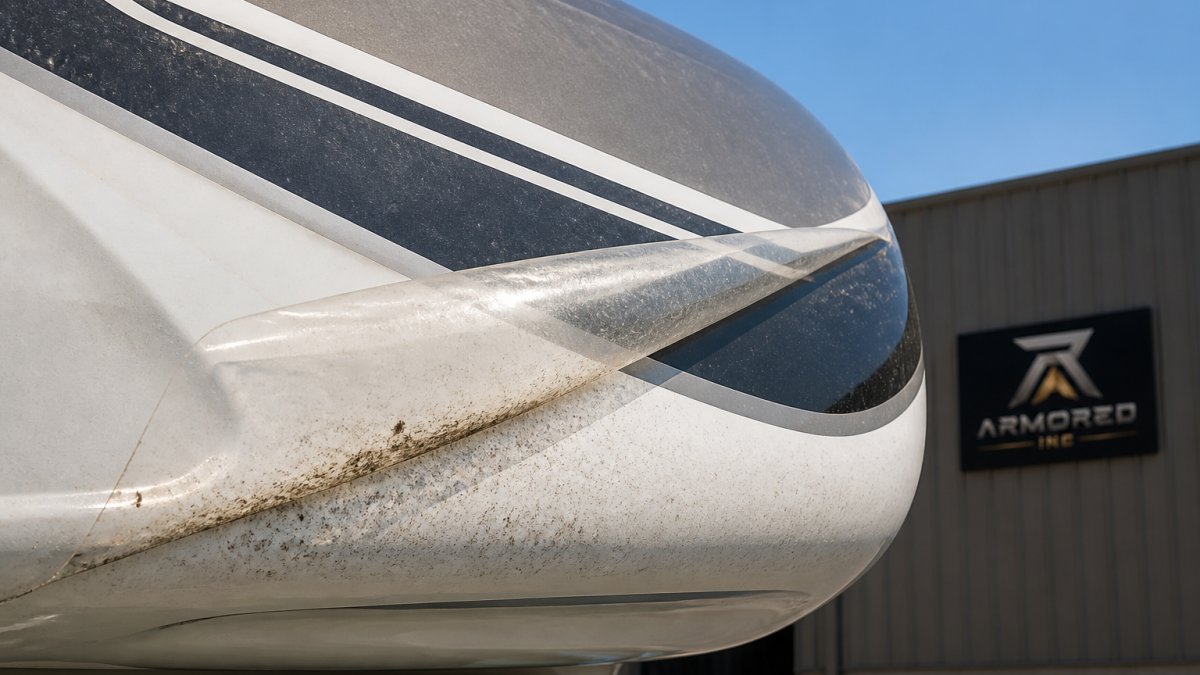
Paint protection film is a clear urethane layer bonded to your RV's paint to absorb impacts and block contaminants. Also called clear bra, it works only while its edges stay sealed.
This guide from Armored Inc. covers what peeling film does, how to tell film failure from paint failure, and your repair options.
What to Do the Moment an Edge Lifts
Here is the ordered sequence that actually limits damage before your assessment:
- Do not pull, stretch, or peel the film back. Pulling a lifted edge is the fastest way to lift paint with it, since the edge bond is already compromised.
- Do not trim the lifted edge with a knife or scissors. A ragged cut creates a new edge that catches wind and water and lifts faster than the original.
- Press the edge down gently with a clean, dry microfiber cloth, light finger pressure only, no heat. If it will not stay down, leave it.
- Keep the lifted area clean and dry. Rinse away loose grit with low-pressure water, then blot dry. Do not scrub, and do not aim a pressure washer anywhere near the edge.
- Photograph the peel from a few feet back and close up, in daylight, with something for scale. Note the date, this becomes your warranty and insurance record.
- Book an assessment before your next long drive. Highway wind works under a lifted edge and drives grit deeper into the adhesive gap.
The Risks Stack Up Quickly
Once an edge is open, damage is cumulative:
- Water intrusion under the lifted edge, which traps moisture against the paint
- Dirt and sand grinding between film and clear coat as you drive
- Mold and mildew growing in the damp gap, especially in humid storage
- Staining and discoloration where trapped debris sits for months
On an RV, the front cap and cab-over take the worst of it, facing constant wind, bugs, and road spray, so their edges lift first. A lift on a flat side panel is usually slower than one on a curved front cap, where water pools.
Why RV Paint Protection Film Peels or Lifts
Adhesive failure is the usual cause, and it rarely happens overnight. The film-to-paint bond breaks down for a few reasons:
- Poor surface preparation at installation, such as wax or dust left under the film
- Repainted or weakly bonded surfaces that the adhesive never fully gripped
- Weather exposure, since UV and temperature swings age the adhesive
- Pressure washing forced under a film edge
If you are unsure whether the lift is new, compare it against the film on the opposite side. A flat edge on one side and a curl on the other points to an installation or surface issue, not normal aging.
Is It Normal for RV Paint Protection Film to Peel?
Some edge lifting is normal over time, but peeling within the film's expected lifespan points to an installation or surface problem. A sealed edge should hold for years; a corner that curls within months should not.
Location matters too. A small lift on a flat panel is minor; the same lift on a curved front cap, where water pools, is urgent.
How to Distinguish Peeling PPF from Clear-Coat or Paint Failure
Peeling film and failing paint can look similar from a few feet away but behave differently. Knowing which you have changes the fix.
Here is how to tell them apart:
| Sign | Peeling PPF | Clear-Coat or Paint Failure |
|---|---|---|
| What lifts | A flexible film layer with a visible edge | A chalky, thin layer that flakes |
| Feel | Plastic-like, peels in sheets | Powdery or brittle to the touch |
| Appearance | Film edge curls, traps dirt | Cloudy, oxidized, or faded patch |
| Fix | Reattach, replace, or remove film | Repaint or refinish the panel |
If the lifting material feels like thin plastic and peels in one piece, it is film.
A common mistake is assuming every peel is a film problem. Checking the paint underneath before recommending any repair is crucial.
RV Paint Protection Film Peeling Repair: Your Options
Repair depends on how much film has lifted, whether the paint below is sound, and where the failure sits. A small, clean lift on a flat panel can often be reattached; a large, contaminated peel usually needs replacement; film that failed across a whole panel is best removed.
The decision comes down to three paths:
- Reattachment for small, clean lifts with intact adhesive
- Partial replacement for one damaged panel or section
- Full removal when film has aged out or failed across the RV
Reattachment, Partial Replacement, or Full Removal
Use this decision guide to pick your path:
- If the lift is under 2.5 cm and clean, reattachment may work
- If dirt or water is trapped underneath, partial replacement is safer
- If the film is near the end of its lifespan, full removal avoids repeat repairs
- If the paint underneath is damaged, address the paint before new film goes on
RV-Specific Factors That Change the Decision
General automotive PPF pages treat every panel the same. On an RV, these details matter:
- Panel material. Many RV bodies are fiberglass or composite, which flexes differently under heat and wind load, so a reattached edge is more likely to lift again.
- Seams and trim. Film running into a seam, clearance light, or trim strip has less room to move, so a lift there often needs trimming back to a clean line rather than pressing down.
- Curves and the front cap. Compound curves on a cab-over or front cap hold more tension, which pulls a reattached edge back up, so curved panels lean toward replacement.
- Prior repainting. If the panel was repainted at any point, the bond between new paint and the original surface may be weaker than the film's adhesive. In that case, removal can take paint with it, and the safe path is often to leave the film in place until a professional assesses the paint.
Repair, Replace, or Remove: A Practical Comparison
| Situation | Likely Path | Why |
|---|---|---|
| Small clean lift, flat panel, film still young | Reattachment | Adhesive is intact and the panel does not fight the bond |
| Lift with visible grit or moisture underneath | Partial replacement | Contamination cannot be cleaned out reliably once it is under the film |
| Film aged out across multiple panels | Full removal | Chasing individual lifts costs more than starting fresh |
| Lift over a prior repaint | Professional assessment first | Removal risk to the paint may outweigh the benefit |
| Lift on a curved front cap or cab-over | Replacement | Tension on the curve pulls reattached edges back up |
For RV owners in Barrie, an on-site assessment is often recommended first. What looks like a small lift often hides contamination along the whole edge, and inspecting before the first hard freeze avoids working with brittle film and cold adhesive.
What to Document Before You Book Anything
Warranty and insurance outcomes often depend on records you gather now:
- Photos of the peel from a distance and close up, in daylight, with scale
- Your original installation paperwork, including the date and the film brand
- Your washing and storage habits, whether you pressure wash, where the RV is stored, and whether it sits in sun or shade
- Any prior paint or bodywork on the affected panel
Check your film's written warranty terms. Manufacturing defects such as premature adhesive failure are commonly covered; damage from pressure washing, impact, or neglected maintenance usually is not. Coverage varies by manufacturer, so read the specific terms.
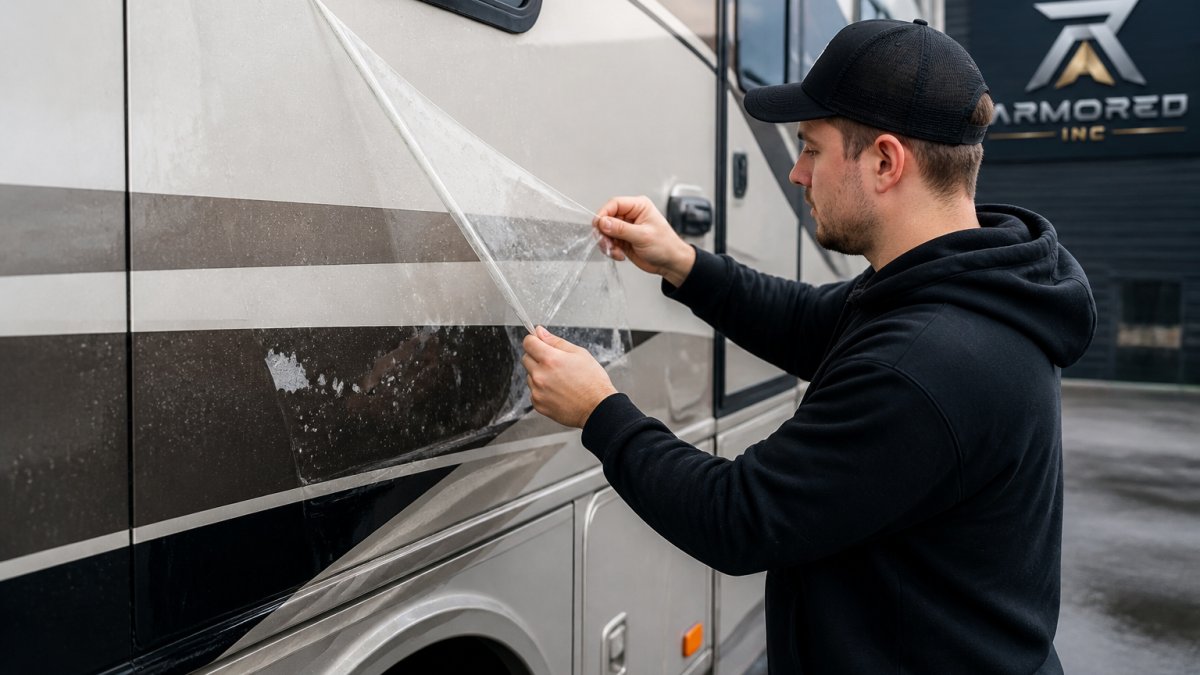
If the film has to come off, removal is a separate skill from installation. Controlled heat, a low peel angle, and patience protect the clear coat, see the steps below before attempting it yourself.
How to Remove PPF from an RV Without Damaging Paint
Removing PPF safely means controlled heat, patience, and the right angle. Pull too fast or too cold, and you risk paint lifting with the film.
Follow these steps:
- Park in shade and let the surface cool to a safe working temperature
- Apply gentle heat with a heat gun or steamer to soften the adhesive
- Peel at a low angle, keeping the film close to the panel
- Work in small sections, reheating as the adhesive stiffens
- Clean the residue with a film-safe adhesive remover
- Inspect the paint for any lifting before new film goes on
Speed is the enemy of removal. Slow, steady pulls protect the clear coat; fast yanks take paint with them.
Matte paint leaves an even smaller margin for error, since it shows every imperfection. Removal should be handled by someone with matte film experience.
RV Paint Protection Film Lifespan: What to Expect
A quality film typically lasts several years with proper care, though life depends on sun, storage, and washing. Film on a sun-facing front cap ages faster than film on a shaded side panel.
You can extend film life with a few habits:
- Wash gently and skip pressure washing near film edges
- Park under cover when you can
- Apply a film-safe sealant to keep the surface slick
- Check edges each season for early lifting
PPF Warranty for Peeling: What's Covered and What Isn't
Warranty coverage for peeling depends on the film brand, installer, and cause. Manufacturing defects like premature adhesive failure are often covered; damage from pressure washing, accidents, or poor maintenance usually is not.
Keep these records to support a claim:
- Your original installation paperwork and date
- Photos of the peel as it develops
- A record of how the RV is washed and stored
Coverage terms vary by manufacturer, so check your specific film's warranty terms and ask your installer to walk you through them. Armored Inc. aims to ensure clarity regarding warranty coverage before installation.
Conclusion
A peeling film edge is easy to ignore and expensive to neglect. Water, dirt, and mold work under the film, and the paint underneath pays the price.
If your RV paint protection film is lifting, do not pull at it. Get it assessed.
Contact us to book an inspection and protect your RV's finish before a small lift becomes a full repaint.
Frequently Asked Questions
Is it normal for RV paint protection film to peel?
Some edge lifting is common over time, especially on RVs exposed to Ontario winters and road debris. However, widespread peeling within the first few years usually points to installation issues, poor surface preparation, or a defective film batch. If peeling starts early, document it and contact your installer, as RV paint protection film lifespan varies by product quality and maintenance.
Can peeling PPF be removed without damaging RV paint?
In many cases, yes, but it depends on the adhesive bond and paint condition. If the paint underneath is original and well-bonded, a professional can often remove the film safely using heat and controlled peeling. If the surface was repainted or the adhesive has bonded too strongly, removal can pull paint. A professional assessment is the safest first step before attempting removal.
Should you replace the whole PPF panel or just the peeling section?
It depends on the extent of the peeling and the age of the film. If the film is relatively new and only a small edge has lifted, a targeted repair may work. If the film is older or peeling across multiple areas, partial or full replacement of that panel is usually more reliable. A professional can assess whether reattachment, partial replacement, or full removal makes sense for your RV.
Does a PPF warranty cover peeling on an RV?
Most PPF warranties cover manufacturer defects like premature yellowing, cracking, or adhesive failure under normal conditions. Peeling caused by poor installation, physical damage, or lack of maintenance is typically not covered. Check your warranty terms and keep your installation paperwork. If peeling starts, contact your installer promptly with photos and details of when it began.