 Comparison
Paint Protection Film for Motorcycle Tanks: A Real-World Review
Last Updated: November 21, 2026
Quick Summary
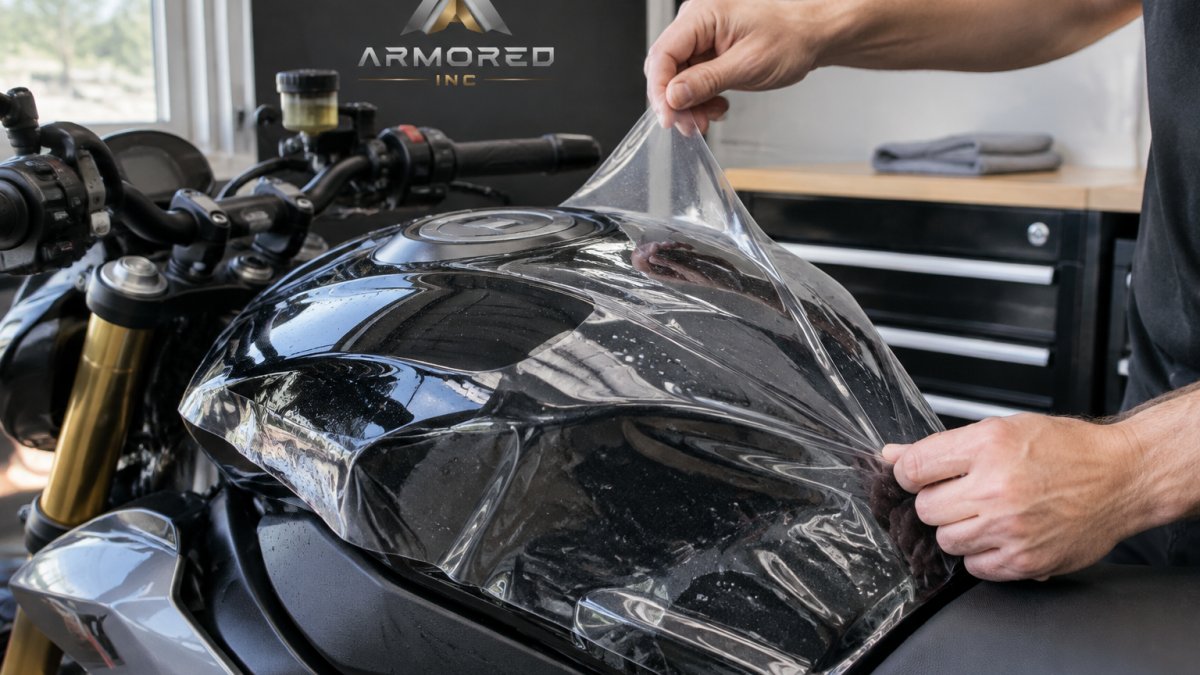
Motorcycle tank protection film is a clear urethane layer that absorbs scratches, scuffs and stone chips before they reach your paint. Pre-cut kits suit most riders, while professional installs cost more but handle surface prep and edges properly. Film stops soft abrasion but not heavy bags or metal buckles grinding on the tank.
- A fuel tank sits directly behind the front wheel, in the debris path.
- Pre-cut kits typically cost $80 to $160 in Canada.
- Professional installed coverage runs about $350 to $650.
- Matte paint needs matte film; gloss film permanently changes the finish.
- Confirm the template covers your model year and the filler neck surround.
Table of Contents
- What Motorcycle Tank Protection Film Actually Does
- The Best Motorcycle Tank Protector Film Options Compared
- Motorcycle Tank Bag Scratch Protection: What Film Can and Cannot Stop
- Motorcycle Tank PPF Installation: DIY or Professional?
- Motorcycle Paint Protection Film Durability and Local Riding Conditions
- Coverage, Fit and Paint Compatibility: What Riders Get Wrong
- Book a Tank Film Assessment in Barrie
- Frequently Asked Questions
What Motorcycle Tank Protection Film Actually Does
Motorcycle tank protection film is a clear urethane layer that bonds to painted surfaces and absorbs the damage that would otherwise reach your clear coat. Fuel tanks are among the most exposed painted panels on a motorcycle. Your knees grip it. Your jacket zipper grazes it at every stop. Stones thrown by the front tire hit it square on.
The physics are simple. A fuel tank sits directly behind the front wheel, low and forward, in the debris path. No other painted panel takes that combination of road spray and rider contact.
Scratches, Scuffs and Abrasion
Most tank damage never comes from a crash. It comes from repetition. A zipper pull that touches the paint twice a day for three seasons leaves a dull patch that no polish will fully remove. Tank bag straps work the same way, grinding grit into the clear coat as the bag shifts.
Film takes that wear instead. A quality kit adds a sacrificial layer measured in microns, and when it dulls, it gets replaced rather than the paint.
Stone Chips and Road Debris
Chips are impact damage, and they behave differently from scratches. A stone striking the tank at highway speed can crack through the clear coat and base coat in one hit, leaving a white or grey mark that stands out against gloss or matte finishes alike.
Film spreads that impact across its surface. The chip may still mark the film, but the paint underneath usually survives. Bug impacts and road grit cause the same slow pitting over a season of riding.
The Best Motorcycle Tank Protector Film Options Compared
Here is the honest version: the best motorcycle tank protector film depends on whether you want a kit you install yourself or a full professional coverage plan. We evaluated options on film material, fitment method, stated guarantees, and how well each suits a Canadian rider's season. Kit prices vary by model year and tank shape, and current pricing depends on the product and installer, so check with the maker or Armored Inc. for a quote.
| Option | Format | Stated Strength | Typical CAD Price Range | Best For |
|---|---|---|---|---|
| Armored Inc. | Professionally installed, model-specific coverage | Matte and gloss film expertise, in-house installation | $350-$650 installed (varies by coverage) | Riders who want the tank done right once |
| XPEL Ultimate Plus | Professional film, dealer-installed | Premium film named a leading overall pick in buyer guides | $300-$550 installed through dealers | Panel-by-panel coverage planning |
| Tony James Designs | Precision-cut, self-healing kit | Model-specific pre-cut fitment | $80-$160 kit only | Riders confident with self-installation |
| Tankslapper | Removable film kit | Reported as durable and removable | $60-$120 kit only | Riders who want reversibility |
| Lamin-x Tank Guards | Clear tank guard | Stated 5-year guarantee | $50-$110 kit only | A straightforward clear guard |
How We Evaluated These Kits
Kit prices vary by model and maker, so compare what each option covers and how it fits your specific tank rather than price alone.
A note on what most reviews miss: a pre-cut kit is only as good as its template for your exact model year. A kit that fits a 2020 tank may leave gaps on a facelift model with a reshaped knee recess. Before buying, confirm the template covers your model year and ask whether the kit includes the filler neck surround, which is the most chip-prone area on many tanks.
SEMA guidance on paint protection film standards
If you are comparing what professional film work costs before choosing a kit, our guide to Paint Protection Film Pricing Ontario: A 2026 Guide breaks down how Ontario pricing is structured.
Typical CAD Price Ranges for Motorcycle Tank Protection Film Options
Motorcycle Tank Bag Scratch Protection: What Film Can and Cannot Stop
Film stops abrasion from soft contact: straps, fabric, zipper pulls, and knees. It does not stop everything, and pretending otherwise leads riders to skip the precautions that actually matter.
What film handles well:
- Tank bag straps resting against painted flanks
- Jacket and glove contact at stops
- Light grit trapped under a bag
- Stone chips and bug impacts
What film cannot fix:
- A heavy bag loaded past its mount and shifting under braking
- Metal buckles or hard plastic clips grinding directly on the surface
- Grit trapped between the bag base and the tank for a full season
The practical fix is a film layer plus a clean mounting surface. Wipe the tank before every long ride with a bag fitted. Grit under a padded base acts like sandpaper, and no film lasts forever under that.
Motorcycle Tank PPF Installation: DIY or Professional?
Installation is where most tank film projects succeed or fail. The film itself is forgiving; the surface preparation and edge work are not.
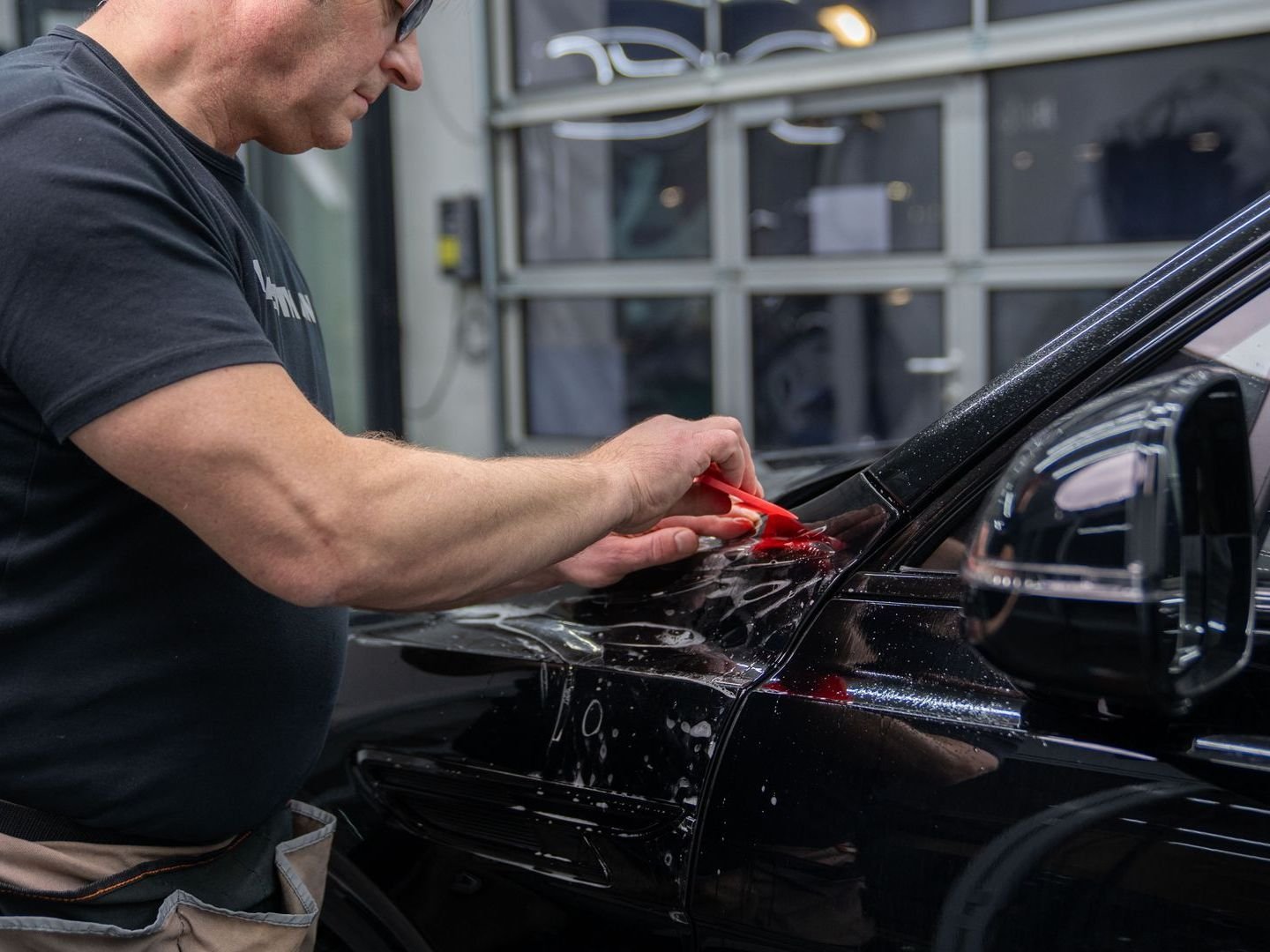
A pre-cut kit is the middle path. The template handles the trimming, and you handle the application. Cut-to-fit film comes as a larger sheet you trim on the bike, which demands more skill and risks a blade near fresh paint. A universal sheet is the cheapest route and the least likely to look clean on a curved tank with compound curves.
Pre-Cut Kit vs Cut-to-Fit vs Universal Sheet
Pre-cut kits win for most riders. The manufacturer has already mapped the tank's curves, so your job is alignment and squeegee work. Cut-to-fit suits installers who want coverage beyond what a template offers. Universal sheets make sense only for flat or simple panels, which a motorcycle tank is not.
If you are weighing the two paths, our step-by-step PPF installation guide covers the full process, and the professional installation guide explains what a proper shop install involves.
Common Installation Mistakes
- Applying film to a tank that is not surgically clean. Any wax residue or dust trapped under the film becomes a permanent visible speck.
- Skipping a slip solution and trying to position dry film. You get one chance at alignment and no chance to fix it.
- Stretching film past its tolerance around the filler neck. Overstretched film lifts at the edges within weeks.
- Working in a cold garage. Film needs warmth to conform; cold film fights every curve.
- Ignoring the edges. Lifted edges collect dirt and eventually peel back across the panel.
Watch out: trimming cut-to-fit film on the bike with a blade can score the clear coat if the tip slips, and that damage is not reversible with polish.
Motorcycle Paint Protection Film Durability and Local Riding Conditions
Durability depends more on your riding environment than on the film brand. A tank that sees year-round commuting, road salt spray, and gravel shoulders ages faster than one on a fair-weather bike. In Barrie and the surrounding Simcoe County area, riders get a specific mix: sand and salt residue in spring, fresh chip seal in summer, and cold storage months that stress film edges as temperatures swing.
Cold weather changes how film behaves at every stage. Film generally needs warmth to conform around compound curves, so installation in a cold garage can be difficult. Once applied and fully cured, quality film handles Ontario winters well, but seasonal storage matters.
Film thickness matters here. Thicker film absorbs bigger impacts but conforms less easily around tight curves. Self-healing top coats handle light swirl marks from washing, but they do not repair a deep gouge. Film lifespan depends on riding use and storage, and a daily-ridden bike will generally wear film faster than a fair-weather bike. If you want the broader case for film before committing, our guide on whether PPF is worth it covers the trade-offs.
Transport Canada vehicle safety and surface standards
Coverage, Fit and Paint Compatibility: What Riders Get Wrong
The most common mistake is assuming any film is safe on any finish. Matte paint needs matte film; gloss film on a matte tank turns it glossy and the change is permanent until removal.
Coverage is the second trap. A partial kit that covers the knee recesses but stops short of the filler neck leaves the most chip-prone area exposed. Ask what the template actually covers before you buy, and check it against your model year.
Removal deserves a mention. Quality film peels cleanly from factory paint, but film applied over a repainted or poorly prepped panel can lift paint on removal. If your tank has been refinished, tell your installer before the film goes on.
Canadian Standards Association guidance on protective coatings
Book a Tank Film Assessment in Barrie
Choosing film for a motorcycle tank comes down to three decisions: how much of the tank you want covered, whether you install it or a shop does, and whether your finish is gloss or matte. Get those right and the brand question mostly answers itself.
If you are local, we can look at your tank in person and tell you what coverage makes sense for how you ride. Armored Inc. offers mobile and valet options in Barrie. Ask us about paint protection film and ceramic coatings for your vehicle.
For riders ready to move from research to a plan, our Paint Protection Film in Barrie: Complete Guide covers service options and next steps.
A tank that chips and dulls in its first few seasons is expensive to refinish and hard to match. We would rather protect it before the damage is done. Get started with Armored Inc. and give your tank coverage that holds up to Ontario roads, with matte-safe film, in-house installation, and mobile or valet service that fits your schedule.
Frequently Asked Questions
Does paint protection film protect a motorcycle tank from scratches?
Yes. A clear film creates a sacrificial layer over the paint that absorbs scuffs from rider gear, tank bags and road debris. It handles light abrasion and stone chips well, but it is not armor: a heavy impact or a sharp metal buckle can still mark the paint underneath. Choosing a kit with good thickness and full tank coverage, and replacing worn film before it wears through, is what keeps the paint underneath intact.
Will a tank bag scratch motorcycle paint through protective film?
A tank bag resting on film is far safer than one resting on bare paint. The film takes the rubbing, and self-healing topcoats can reduce fine marks over time. The risk rises when grit gets trapped between the bag and the tank, so clean the contact area before every ride and check the film for embedded dirt. For heavy touring use, look for a kit that covers the full tank-bag contact zone rather than just the center strip.
Can you install paint protection film on a motorcycle tank yourself?
It is possible with a pre-cut kit, but the tank is one of the harder panels to film. Compound curves, a filler cap opening and tight edges all demand stretching and repositioning. Riders who try it should work in a dust-free space, use plenty of slip solution, and keep a squeegee and heat gun on hand. If the kit is model-specific and expensive, professional installation is usually the safer choice.
How long does motorcycle tank protection film last?
Most quality films are designed to last several years, but motorcycle tanks age faster than car panels because of fuel spills, sun exposure and constant contact. Expect the film to need closer inspection after two to three seasons of heavy riding. Store the bike out of direct sun and clean the film gently to get closer to the upper end of that range.
Can paint protection film be removed from a motorcycle tank without damaging the paint?
Removal is generally safe when the film was applied to sound, original paint and is peeled off correctly. Warm the film gently, lift a corner and pull at a low angle. Repainted or poorly prepped surfaces carry more risk, and old film left on for many years can leave adhesive residue that needs a proper cleaner. Have a professional remove film if the paint is custom or the film has been on for a long time.