 how-to
Protecting Office Countertops from Wear: 2026 Guide
Table of Contents
- Why Office Countertops Wear Faster Than Residential Surfaces
- What You'll Need Before You Start
- Preventing Countertop Scratches in High-Traffic Areas
- Sealing Natural Stone: Granite, Marble, and Quartz Surfaces
- Ceramic Coating for Commercial Surfaces
- Commercial Countertop Maintenance Tips for Daily Wear and Tear
- Long-Term Cost-Benefit: Protecting Office Countertops vs. Replacing Them
- Common Mistakes to Avoid When Protecting Office Countertops
Last Updated: August 18, 2026
Why Office Countertops Wear Faster Than Residential Surfaces
Office countertops face punishment that residential surfaces never encounter. A commercial break room counter used by dozens of people daily accumulates damage from coffee mugs dragged across the surface, laptops slid back and forth, keys dropped on edges, and cleaning crews using wrong chemical agents. Each incident is minor in isolation, but together they strip finishes, create micro-scratches that trap bacteria, and accelerate degradation that takes residential counters decades to accumulate.
Protecting office countertops differs fundamentally from home care because the threat profile is different. High-traffic commercial environments introduce daily wear from multiple users, inconsistent cleaning agents, and constant abrasive contact. Natural stone surfaces like granite and marble are especially vulnerable to etching from acidic spills, a problem that compounds when nobody owns responsibility for immediate cleanup.
The good news: most damage is preventable. Below, we'll walk through exactly what that looks like, from physical barriers to sealing protocols to ceramic coating options designed for commercial longevity.
What You'll Need Before You Start
Before committing to any protection strategy, assess what you're working with. The material determines the method.
Surface identification checklist:
- Identify the countertop material (granite, marble, quartz, laminate, concrete, solid surface)
- Check whether natural stone has been previously sealed (water bead test: drop a few millilitres of water on the surface; if it absorbs within a few minutes, it needs sealing)
- Note existing damage: scratches, etching, staining, chips
- Identify the highest-traffic zones and the most common hazard types (spills, abrasion, impact)
- Confirm what cleaning products are currently used by your facilities team
Materials and supplies to gather:
- pH-neutral stone cleaner or mild dish soap
- Microfibre cloths (not paper towels, which cause micro-scratches)
- Penetrating stone sealer appropriate to your material
- Protective desk pads, mats, or film rolls
- Felt pads or rubber bumpers for equipment feet
The cleaning product your facilities team uses matters as much as the protective coating you apply. Harsh chemical exposure from bleach-based or acidic cleaners will degrade both the surface and any sealant over time. Audit your cleaning supplies before spending anything on protection.
| Surface Type | Sealing Required | Scratch Resistance | Stain Resistance | Priority Action |
|---|---|---|---|---|
| Granite | Yes | High | Medium (unsealed) | Seal every 1-2 years |
| Marble | Yes | Low | Low (unsealed) | Seal every 6-12 months |
| Quartz | No | High | High (non-porous) | Protective film for abrasion |
| Laminate | No | Low | Medium | Physical barriers |
| Concrete | Yes | Medium | Low (unsealed) | Seal and wax regularly |
Preventing Countertop Scratches in High-Traffic Areas
The biggest mistake with scratch prevention is treating it as an afterthought. Most offices install beautiful countertops and then immediately place unprotected equipment directly on the surface. Scratches from abrasion are the most common form of surface damage in commercial spaces, and they're almost entirely preventable.
Protective Films and Physical Barriers
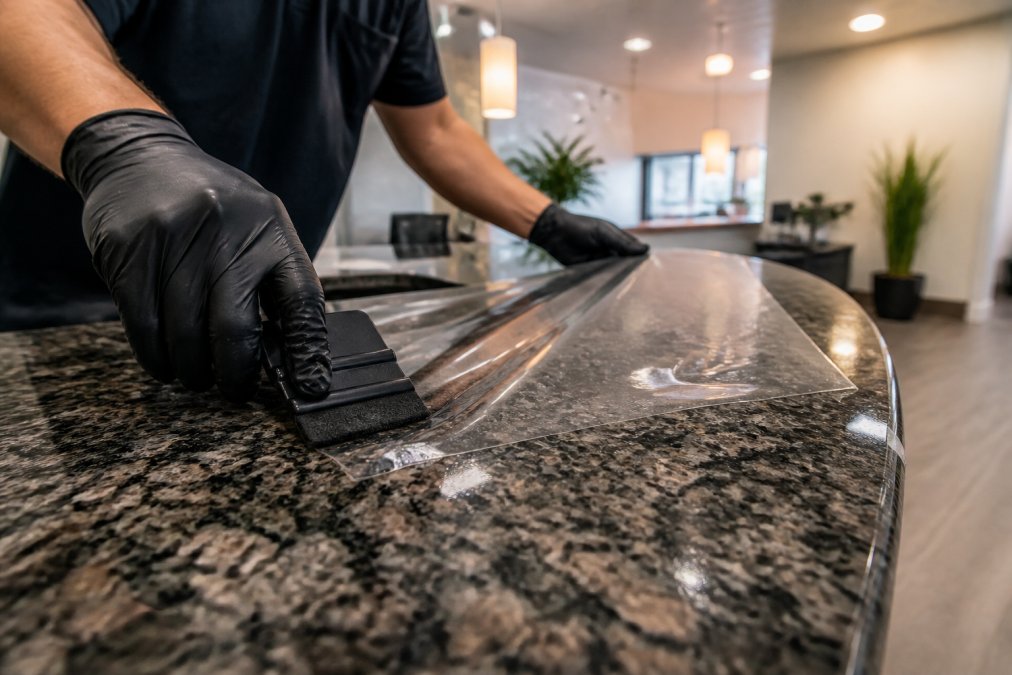
Protective film is the most immediate and cost-effective solution for high-abrasion zones. A clear, self-adhesive film applied to the countertop surface creates a sacrificial layer that absorbs scratching and impact without touching the stone beneath. According to Natural Stone Institute guidance on surface protection, physical barriers are the first line of defense recommended for commercial stone installations in high-traffic environments.
For reception desks and workstations where equipment is placed and moved regularly, a film rated for scratch and impact resistance gives meaningful protection without altering appearance. Films can be replaced when worn, far less expensive than countertop restoration.
Rubber-backed desk mats serve a similar function for work surfaces. The key is ensuring the mat's underside is soft and non-abrasive; some rubber compounds will scratch stone if dragged.
Ergonomic Desk Accessories That Double as Surface Protection
Ergonomic desk accessories are also surface protection tools. Monitor risers with felt or rubber feet eliminate micro-abrasion from bare bases. Keyboard trays keep keyboards off the countertop entirely. Cable management systems reduce scratching from dragged cables. Desk organizers with padded bases prevent repetitive contact damage from pens and staplers.
The ergonomic benefit and surface protection benefit are the same product decision. Outfitting a workstation properly for user comfort also prevents the daily wear that accumulates into visible surface damage.
Sealing Natural Stone: Granite, Marble, and Quartz Surfaces
Sealing natural stone is not optional in a commercial environment. It is the single most important preventative care step for granite and marble surfaces.
Natural stone sealing fills the microscopic pores of the stone with a penetrating impregnator, creating a barrier against moisture, oil, and staining agents. Unsealed granite and marble are porous; spills penetrate and cause staining that cannot be removed without professional restoration. Etching, a chemical reaction between acidic liquids and calcium carbonate in marble, happens regardless of sealing, but proper maintenance significantly slows progression.
Quartz is non-porous by design and and doesn't require sealing. Its stain resistance is built into the material. The vulnerability for quartz is abrasion and impact, not moisture infiltration.
Sealing schedule for commercial environments:
- Test the current seal every six months using the water bead test
- Reseal granite annually in moderate-traffic areas, every six months in high-traffic zones
- Reseal marble every six to twelve months depending on use
- Always clean and dry the surface completely before applying sealer
- Apply sealer in thin, even coats and buff off excess before it dries
Eco-Friendly and Non-Toxic Sealant Options
Conventional stone sealers have historically contained volatile organic compounds that create air quality concerns in enclosed commercial spaces. Water-based, low-VOC penetrating sealers now perform comparably to solvent-based alternatives for most commercial applications. They cure faster, produce less odour, and are safer for staff remaining in the building during application. According to Health Canada's guidance on indoor air quality in commercial buildings, minimizing VOC exposure from maintenance products is a recommended practice for building operators.
When evaluating sealers, look for products that explicitly state VOC content and carry third-party environmental certifications. The surface finish and protection duration should be comparable to conventional options.
Ceramic Coating for Commercial Surfaces
Ceramic coating for commercial surfaces is one of the most durable protection options available and significantly underutilized in office environments.
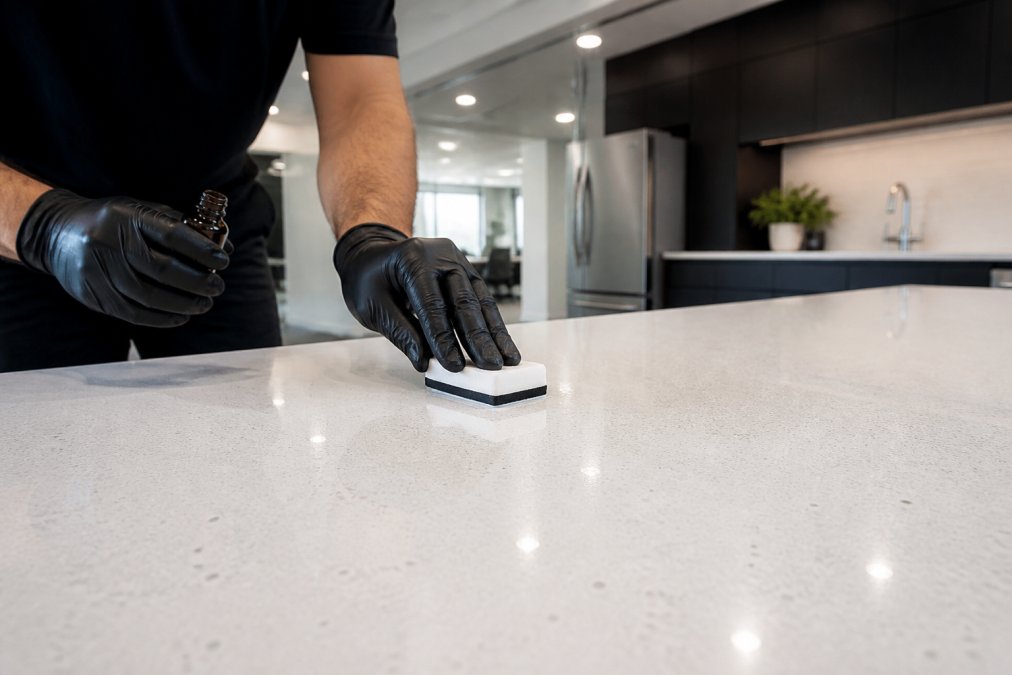
Ceramic coating is a liquid polymer that bonds chemically to a surface, creating a hard, hydrophobic layer that resists staining, chemical exposure, and abrasion. Applied to a countertop, it creates a surface that repels water and oil while adding measurable scratch resistance. The coating becomes part of the surface rather than sitting on top of it, so it doesn't peel or delaminate.
For commercial countertops, the practical benefits are significant:
- Spills bead up and wipe away cleanly, reducing staining risk
- The hydrophobic surface resists bacterial adhesion, which matters in break rooms
- Surface maintenance becomes faster because the coating prevents grime from bonding
- The surface finish is preserved longer, reducing the frequency of professional polishing
Armored Inc. applies professional-grade ceramic coatings to commercial interior surfaces. The coating process requires proper surface preparation; any existing damage, etching, or contamination must be addressed before application to ensure the coating bonds correctly.
Commercial Countertop Maintenance Tips for Daily Wear and Tear
Daily maintenance is where most commercial countertop protection programs break down. The protection strategy is implemented, and then the facilities team reverts to whatever cleaning routine was already in place, often including the exact products that caused the original damage.
A commercial countertop maintenance schedule should be simple enough to follow consistently:
Daily:
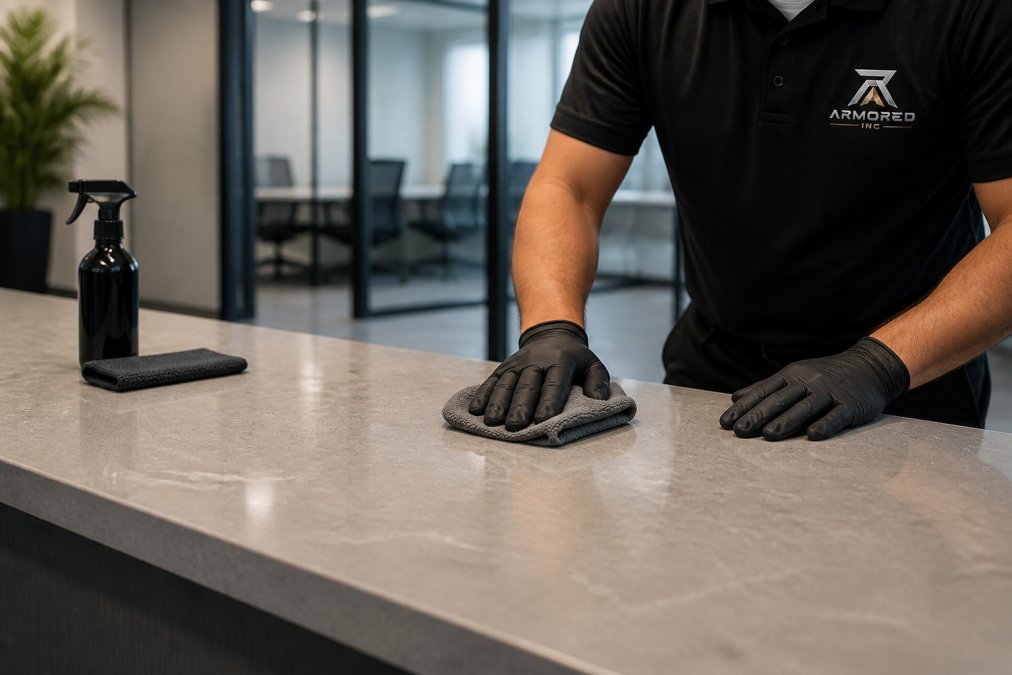
- Wipe surfaces with a damp microfibre cloth
- Use only pH-neutral cleaners; avoid bleach, ammonia, and acidic products
- Address spills immediately, especially coffee, citrus, and wine on natural stone
Weekly:
- Inspect surfaces for new scratches, chips, or areas where protective film is lifting
- Clean with a dedicated stone or surface cleaner appropriate to the material
- Check that desk accessories and equipment feet are properly padded
Quarterly:
- Perform the water bead test on sealed stone surfaces
- Inspect ceramic coating condition and surface integrity
- Schedule professional assessment if wear patterns are developing
Stain Resistance and Spill Management
Stain resistance is not a fixed property of a countertop; it's the outcome of the protection layer on top of it. Unsealed granite stains easily. Properly sealed granite resists most common office spills.
The most damaging spills in office environments are acidic liquids on natural stone: coffee, tea, citrus-based drinks, and sparkling waters. These cause etching on marble and some granites that looks like a dull patch where the surface finish has been chemically altered.
For day-to-day spill management, blot rather than wipe. Wiping spreads the spill and increases surface contact. Blotting lifts it. Then clean the area with a pH-neutral cleaner and dry completely.
Repairing Minor Wear Without Full Replacement
Minor wear doesn't require full countertop replacement. Fine scratches in polished stone can often be addressed with professional buffing and polishing. Deeper scratches in granite or quartz may require colour-matched epoxy fill followed by polishing. Etching on marble can be corrected with diamond polishing pads.
A countertop that looks significantly worn after several years of commercial use may be fully restorable for a fraction of the replacement cost. Professional assessment before committing to replacement is always worth the time.
Long-Term Cost-Benefit: Protecting Office Countertops vs. Replacing Them
The financial argument for protecting office countertops is straightforward. Natural stone countertop replacement in a commercial setting involves material cost, demolition, installation, and operational disruption. Protective maintenance, sealing, ceramic coating, and physical barriers cost a fraction of that, applied annually or biannually. According to Building Owners and Managers Association of Canada on commercial property maintenance, preventative maintenance programs consistently deliver lower lifecycle costs than reactive replacement strategies across all commercial surface types.
A well-protected granite countertop in a commercial environment can maintain its surface integrity for well over a decade. An unprotected one in a high-traffic office may show significant degradation within three to four years. The protection investment pays for itself many times over before replacement would be considered.
There's also a secondary cost: the aesthetic and brand impact of worn surfaces in client-facing spaces. Reception desks and boardroom surfaces with visibly damaged countertops communicate something about how a business operates.
Common Mistakes to Avoid When Protecting Office Countertops
Using the wrong cleaning products. Bleach, ammonia-based cleaners, and acidic products strip sealers, degrade ceramic coatings, and cause direct chemical damage to natural stone. The facilities team needs explicit guidance on approved cleaners.
Skipping surface prep before sealing or coating. Applying a sealer or ceramic coating over a contaminated or damaged surface traps the problem beneath and prevents proper adhesion. The surface must be clean, dry, and free of existing damage.
Treating all stone the same. Marble and granite have different porosity levels, different sensitivities to acids, and different resealing schedules. Quartz requires none of the same sealing attention. A one-size-fits-all approach will underprotect some surfaces.
Waiting for visible damage before acting. Protective maintenance works best as prevention. By the time scratches, etching, or staining are clearly visible, the surface has already sustained damage requiring correction before protection can be applied.
Ignoring the protective film's lifespan. Physical protective films are not permanent. They scratch, lift at edges, and lose effectiveness over time. A peeling or clouded film is no longer protecting the surface beneath it. Build film inspection and replacement into quarterly maintenance reviews.
Protecting office countertops from wear is a commitment that pays off over the full lifecycle of a commercial installation, but only if the protection strategy is matched to the material, traffic level, and actual hazards in the space. Armored Inc. provides professional ceramic coating and surface protection services for commercial interiors, applying the same standards of surface preparation and coating durability that protect high-value automotive and marine surfaces. Contact us to discuss a protection plan for your commercial property.
Frequently Asked Questions
What is the best protective covering for office countertops?
The best option depends on the surface material and traffic level. For natural stone like granite or marble, a penetrating sealer combined with a professional ceramic coating offers strong stain resistance and scratch protection. For laminate surfaces, protective films and desk pads handle daily abrasion well. High-traffic commercial spaces benefit most from a layered approach: physical barriers for impact resistance plus a chemical coating to guard against moisture and chemical exposure.
Do commercial-grade ceramic coatings work on office countertops?
Yes. Commercial ceramic coatings bond to most hard surfaces, including quartz, granite, marble, and sealed laminate. Once cured, they create a non-porous, scratch-resistant layer that repels liquids and resists etching from common office cleaning agents. The coating also simplifies daily maintenance because spills wipe away before they penetrate the surface. For best results, have a professional apply the coating after a thorough surface preparation and cleaning.
How often should office countertops be resealed or treated?
Natural stone countertops in commercial settings typically need resealing every 12 to 24 months depending on traffic volume and the cleaning products used. Ceramic coatings last longer, often three to five years, before a reapplication is needed. A simple water-bead test tells you when a stone surface needs attention: if water soaks in rather than beading up, the seal has worn down. Establishing a maintenance schedule and logging treatment dates keeps surface integrity consistent.
How do you remove common office stains from stone countertops?
For most stains on granite or marble, a poultice made from an absorbent powder mixed with a mild cleaning agent draws the stain out of the stone as it dries. Coffee, ink, and food stains respond well to this method. Avoid acidic cleaners on marble, as they cause etching. For sealed or coated surfaces, a pH-neutral cleaner and a soft cloth handle most spills without damaging the surface finish. Treat spills immediately to prevent deep penetration.
This article was written using GrandRanker