 how-to
7 Ways to Prevent Swirl Marks on a New Car
Last Updated: November 4, 2026
Quick Summary
To prevent swirl marks on a new car, wash with the two-bucket method using grit guards, dry with plush 400 GSM or higher microfiber towels by patting instead of scrubbing, and skip automatic brush washes. Adding a ceramic coating reduces the micro-marring from washing and drying that causes most swirl marks.
- Use two buckets with grit guards, rinsing your mitt before reloading with soap.
- Choose edgeless microfiber towels of 400 GSM or higher and pat the paint dry.
- Wash top-down and pre-rinse with pressure before your mitt touches the paint.
- Avoid automatic brush washes, which carry grit from every car before yours.
- In Barrie, rinse salt off every few weeks and book protection before brine season.
Table of Contents
- What Actually Causes Swirl Marks on a New Car
- Step 1: Use the Two-Bucket Car Wash Method
- Step 2: Pick the Best Microfiber Towels for Car Drying
- Step 3: Wash in the Right Order and Rinse Before You Touch
- Step 4: Skip Automatic Brushes and Touchless Washes That Still Scratch
- Step 5: Add Ceramic Coating for New Cars as a Scratch Barrier
- Step 6: Apply Paint Protection Film for New Cars on High-Impact Panels
- Step 7: Build a Seasonal Wash and Inspection Schedule for Barrie Winters
- Frequently Asked Questions
What Actually Causes Swirl Marks on a New Car
Swirl marks are fine circular scratches in your clear coat that show up as spider-web patterns under direct sunlight. They come from one source: grit dragged across the paint by something softer than the clear coat but harder than dirt.
Your new car's paint is thin. Ontario's road salt, sand, and grit make it worse. Fresh factory paint can pick up its first swirls within weeks when owners use automatic washes or dry-wipe dust off the hood.
Below, we'll show you exactly how to prevent swirl marks on a new car, step by step, from the first wash to winter storage. The seven steps below cover the routine owners can follow from the first wash to winter storage.
Step 1: Use the Two-Bucket Car Wash Method
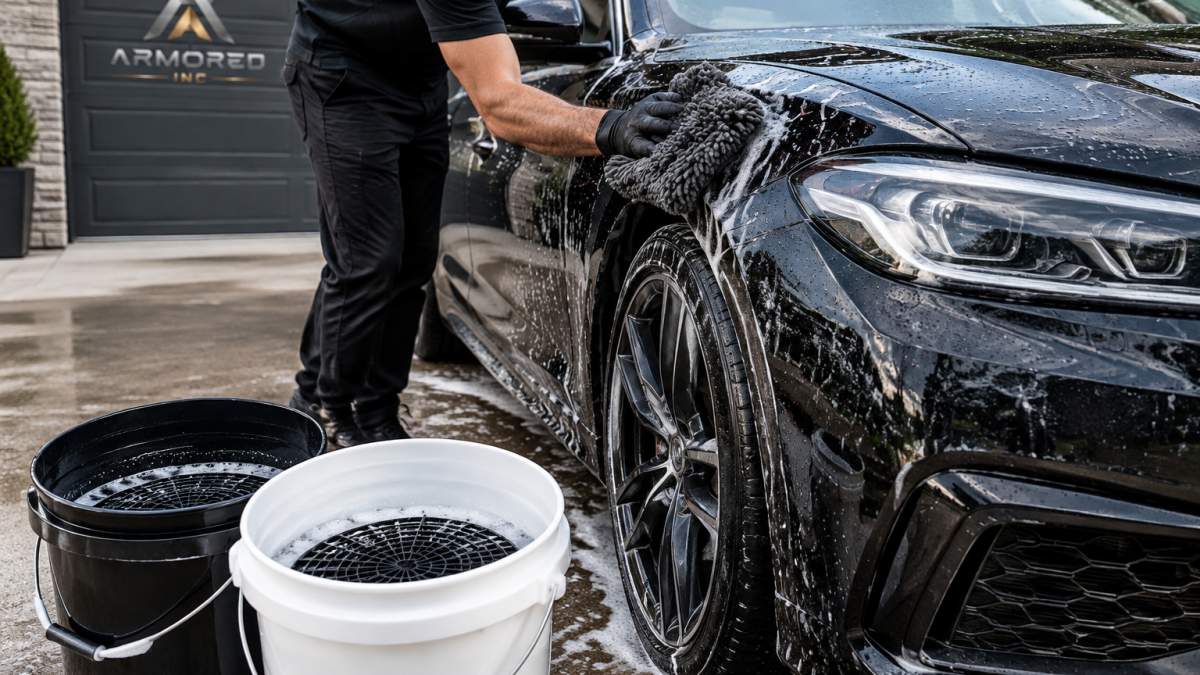
The two-bucket car wash method is the single best way to stop swirls before they start. One bucket holds soapy water, the other holds clean rinse water. You dunk your mitt in the rinse bucket before reloading with soap.
Here's the order:
- Fill bucket one with soap and water, bucket two with plain water
- Add a grit guard to the bottom of each bucket
- Wash one panel, then rinse the mitt in bucket two
- Reload soap from bucket one and move to the next panel
- Rinse the car top-down before you dry
The grit guard traps dirt at the bottom so your mitt doesn't pick it back up. Many owners skip this step, even though it is one of the simplest ways to reduce swirls.
Step 2: Pick the Best Microfiber Towels for Car Drying
The best microfiber towels for car drying are plush, high-GSM towels with a deep pile that lifts water instead of dragging it. Look for 400 GSM or higher and a soft, edgeless border.
Avoid these common mistakes:
- Terry cloth towels from the kitchen
- Old bath towels that have picked up lint and grit
- Chamois leather that traps dirt against the paint
- Any towel that has touched the ground
Pat the paint dry. Don't scrub. Lay the towel flat, let it soak up water, and lift it straight off. If a towel feels rough, it will scratch.
Wash your microfiber towels separately from other laundry. No fabric softener, ever.
Step 3: Wash in the Right Order and Rinse Before You Touch
Wash from the top down, and rinse the whole car before you touch it with a mitt. The roof and glass hold less grit than the lower panels. Starting there keeps your mitt cleaner longer.
Pre-rinse is not optional. A pressure rinse lifts loose dirt off the paint before your mitt ever makes contact. Skip it, and you're grinding sand into the clear coat.
Work in shade where possible, since soap can dry too fast in direct sun and leave spots. Do one section at a time, top to bottom, and keep the surface wet.
Step 4: Skip Automatic Brushes and Touchless Washes That Still Scratch
Automatic brush washes are the fastest way to wreck new paint. The spinning brushes hold grit from every car before yours. That grit goes straight into your clear coat.
Touchless washes are safer, but many use harsh chemicals that strip wax and leave a dull finish. Some still scratch when the high-pressure jets push dirt across the surface.
Wash by hand at home, or use a touchless wash only as a short-term fix in winter. Between snowfalls, rinsing salt off with plain water and drying with a clean microfiber towel is a practical approach. Maintaining the integrity of your clear coat requires strict adherence to specific touchless car wash rules to ensure that high-pressure sprayers do not inadvertently drive grit into the finish.
Step 5: Add Ceramic Coating for New Cars as a Scratch Barrier
Ceramic coating for new cars adds a hard, slick layer on top of the clear coat. Dirt and water slide off instead of sticking, so you touch the paint less. Less touching means fewer swirls. A coating won't stop deep scratches from a key or a shopping cart, but it does reduce the micro-marring that comes from washing and drying, and that is where most swirl marks come from.
What a coating actually does, mechanically: it fills the microscopic pores in the clear coat and creates a hydrophobic surface with a lower friction coefficient. Water beads and rolls off, and grit has less to grab. The result is that your wash mitt glides instead of dragging, and you can dry with less contact. That is the swirl-prevention benefit, not scratch-proofing.
DIY versus professional. A consumer-grade coating kit is within reach of a careful owner, but the prep is where most DIY jobs go wrong. A coating bonds only to clean, decontaminated paint. That means a wash, a chemical decontamination to strip embedded iron and tar, and usually a light mechanical decontamination with a clay bar or clay mitt.
Cost versus likely return. Ceramic coating is a preservation expense, not an investment with a guaranteed payout. Most practitioners treat it as a way to make maintenance washing easier and to slow clear-coat degradation, which supports presentation at resale. It does not reliably add a fixed dollar amount to a trade-in offer.
Armored Inc. offers ceramic coatings and mobile services in Barrie. If you're weighing a coating against a traditional wax or sealant, our guide on ceramic coating vs paint sealant breaks down the difference. When you're ready, you can book ceramic coating in Barrie and we'll walk you through the prep.
A coating applied over contaminated or uncorrected paint can seal in grit and swirls, so prep quality matters.
Step 6: Apply Paint Protection Film for New Cars on High-Impact Panels
Paint protection film for new cars is a clear urethane film that absorbs rock chips and road debris. Put it on the panels that take the most hits: the front bumper, hood, fenders, and mirror caps.
PPF is thicker than a coating. It stops chips that would otherwise break through the paint. It also protects against light scratches from branches and gravel.
Armored Inc. offers paint protection film, including matte paint protection film. If you're deciding between film and a wrap, our comparison of paint protection film vs vinyl wrap covers which one actually protects the paint. For a full breakdown of options and installation, see our paint protection film guide for Barrie.
Step 7: Build a Seasonal Wash and Inspection Schedule for Barrie Winters
Barrie sits in a snowbelt, and that shapes your paint-care calendar more than any product you buy. Road salt, sand, and brine get spread on Highway 400 and the city streets from roughly November through March, and freeze-thaw cycles push that grit into every panel gap and wheel well. Left on the paint, salt holds moisture against the clear coat and accelerates the dulling and micro-marring that shows up as swirls under spring sunlight. A seasonal schedule keeps swirls and rust in check instead of reacting after the damage is done.
Here is the routine we recommend for Barrie owners, with timing built around local conditions:
| Season | Wash Frequency | Key Focus |
|---|---|---|
| Spring (late March-May) | Weekly | Rinse winter salt from rocker panels and wheel wells, inspect for chips and dull spots |
| Summer (June-August) | Every 2 weeks | Shade washing, bug and tar removal, keep the surface wet |
| Fall (September-October) | Weekly | Prep for salt season with wax, sealant, or coating before the first brine application |
| Winter (November-March) | After each snowfall and whenever temperatures rise above freezing | Underbody rinse, dry panels, avoid brush washes |
A few timing rules matter more than the table:
- Wash on the warmest day you get. In Barrie, a January thaw above 0°C is your window. Rinse the underbody and wheel wells first, then wash top-down and dry fully so water doesn't refreeze in seams.
- Don't wait for spring to remove salt. Salt left on for months is what dulls clear coat and starts corrosion at chip edges. A quick rinse every few weeks is cheaper than a paint correction later.
- Inspect after every wash. Look at the hood, front bumper, and mirror caps under direct light for new chips, dull spots, or swirls. Catching a chip before salt gets under the edge is the difference between a touch-up pen and a repaint.
- Book protection before the salt, not after. Fall is the right time to apply a coating, sealant, or film so the barrier is in place when brine season starts.
If you are preparing a vehicle for sale or trade-in, a pre-sale checklist helps you present it fairly without overpromising:
- Wash and dry the exterior, including door jambs and wheel wells.
- Clean glass and mirrors inside and out for visibility and first impressions.
- Vacuum carpets and seats; treat stains and odors.
- Wipe down trim and dash; condition leather if equipped.
- Inspect paint for chips, swirls, and rust; note anything you find.
- Gather maintenance records and disclose existing damage honestly.
Detailing can improve presentation, but it does not change mechanical condition or guarantee a higher appraisal.
If you'd rather hand off the work, our auto detailing service in Barrie covers what a full detail includes and how to plan around the seasons.
Frequently Asked Questions
What causes swirl marks on a new car?
Swirl marks are fine scratches in the clear coat, not the paint itself. They come from grit dragged across the surface during washing and drying, from automatic brush washes, from dry wiping dust off a dirty panel, and from using old towels or sponges that trap debris. A new car is not immune because the clear coat is still soft in its first months. Once the scratches form, they scatter light and read as a dull, circular haze in direct sun.
Does ceramic coating prevent swirl marks?
Ceramic coating for new cars adds a hard, slick layer over the clear coat that reduces friction, so grit slides off more easily and fewer scratches form during washing. It does not make paint scratch-proof. A coated car still needs the two-bucket method and clean microfiber towels. What the coating does is buy you time and make maintenance washes faster, which cuts the number of contact passes that cause swirl marks in the first place.
Does paint protection film prevent swirl marks?
Paint protection film for new cars is the strongest defense against swirl marks because it is a physical urethane layer that takes the scratches instead of your paint. It also absorbs stone chips and road debris. Film is typically applied to high-impact panels such as the hood, bumper and mirrors, so the rest of the car still relies on careful washing. Film is not maintenance-free either: wash it with the same two-bucket method and avoid abrasive polishes.
How often should you wash a new car?
Wash every two weeks in normal conditions and more often in winter, when road salt and brine sit on the panels. In the Barrie area, rinse the undercarriage and lower panels after any drive on treated roads. Do not let dirt build for a month and then scrub hard to remove it, because heavy scrubbing is what creates swirl marks. A quick, gentle wash every couple of weeks beats an aggressive deep clean once a season.
Preventing swirl marks on a new car comes down to one habit: keep grit off the paint and touch it as little as possible. That's harder in Barrie than most places, with salt and sand on the roads half the year. Armored Inc. can help you protect the finish from day one with ceramic coatings, paint protection film, and mobile service that comes to you. Get started with Armored Inc. and keep your new car's paint looking factory-fresh for years.