 listicle
Best Ceramic Coating for Daily Drivers: 2026 Top Picks
Table of Contents
- Quick Comparison: Best Ceramic Coatings for Daily Drivers
- 1. Armored Inc. Professional Ceramic Coating: Best for Harsh Canadian Winters
- 2. Chemical Guys Carbon Force: Best Professional-Grade DIY Option
- 3. Cerakote Platinum Rapid: Best Budget-Friendly Quick Application
- 4. Turtle Wax Hybrid Solutions Ceramic Spray: Best for Beginners
- 5. Adam's Polishes Graphene Ceramic Spray: Best Graphene-Infused Value
- 6. Gtechniq Crystal Serum Light: Best for Long-Term Durability
- 7. Quan Armor Protection: Best for High-Mileage Daily Drivers
- How Long Does Ceramic Coating Last on Daily Drivers?
- Ceramic Coating Maintenance Tips for Ontario Winters
- Professional vs DIY Ceramic Coating Cost
- Frequently Asked Questions
Last Updated: September 14, 2026

Quick Comparison: Best Ceramic Coatings for Daily Drivers
Choosing the best ceramic coating for daily drivers in Barrie comes down to one question: will it survive a Canadian winter? This guide from Armored Inc., a Barrie-based surface protection specialist, ranks seven coatings by real-world durability, application difficulty, and value. Ceramic coating is a liquid polymer that chemically bonds to your vehicle's clear coat, creating a hydrophobic, sacrificial layer against salt, UV degradation, and road grime (pubmed.ncbi.nlm.nih.gov). Below, we break down which products earn their place on a daily commuter.
| Coating | Format | Best For | Approx. Cost |
|---|---|---|---|
| Armored Inc. Professional | Pro-applied | Harsh winters | Quote-based |
| Chemical Guys Carbon Force | Pro-grade DIY | DIY enthusiasts | Contact for pricing |
| Cerakote Platinum Rapid | Rapid DIY | Budget buyers | $30 CAD |
| Turtle Wax Hybrid Solutions | Spray | Beginners | $25 CAD |
| Adam's Graphene Spray | Graphene spray | Value seekers | $50 CAD |
| Gtechniq Crystal Serum Light | Pro-grade DIY | Long-term durability | Contact for pricing |
| Quan Armor Protection | DIY kit | High-mileage drivers | Under $200 CAD |
How We Evaluated These Coatings
We scored each product on four criteria: durability through a Simcoe County winter, ease of application for a non-professional, hydrophobic performance (beading and sheeting), and cost relative to protection window. Products that demand paint correction or a controlled curing environment were flagged, since most daily drivers are coated in a home garage. Canadian pricing was verified where listed; contact-for-pricing items require a dealer quote.
1. Armored Inc. Professional Ceramic Coating: Best for Harsh Canadian Winters
Armored Inc. takes the top spot because no spray-on product matches a professionally applied coating against Ontario road salt. Their ceramic coating service includes full surface decontamination, clay bar treatment, and paint correction before application.
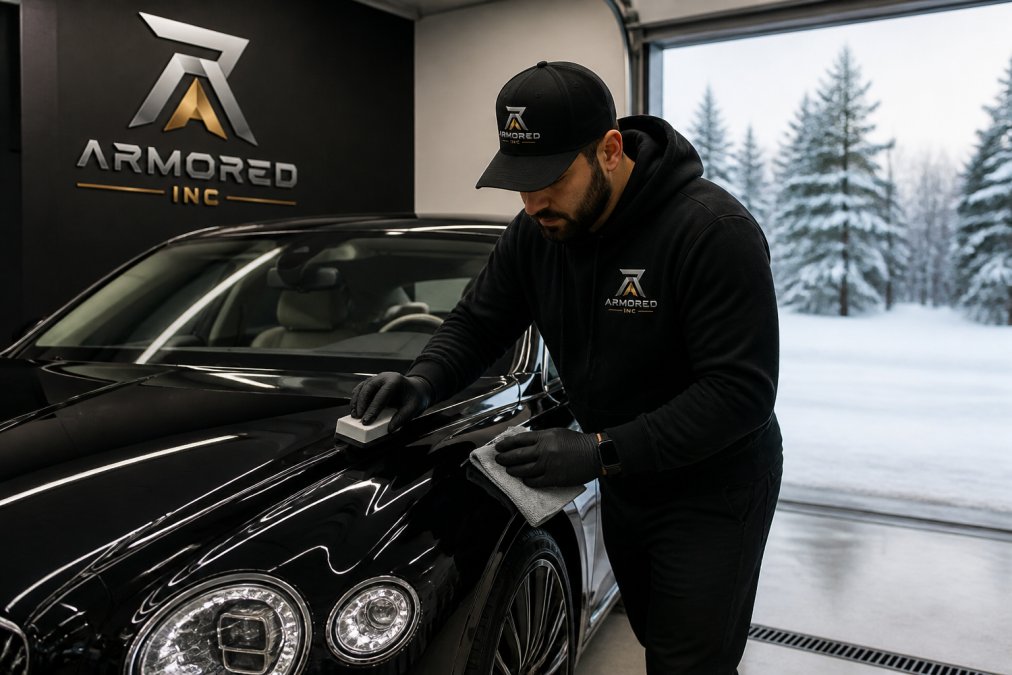
What separates a professional-grade coating from a retail bottle is chemical bonding: the coating cross-links with the clear coat over a controlled curing time, producing a harder, more chemical-resistant surface. Armored Inc. also offers mobile services and valet or rental car options.
2. Chemical Guys Carbon Force: Best Professional-Grade DIY Option
Chemical Guys Carbon Force is the closest a confident DIYer gets to professional results. Its high-solids formula delivers strong hydrophobic properties and resistance to environmental contaminants, and it's a favorite among enthusiasts who already own a dual-action polisher.
The catch: it demands professional application technique. Expect to spend a full day on prep alone.
3. Cerakote Platinum Rapid: Best Budget-Friendly Quick Application
At $30 CAD, Cerakote Platinum Rapid is the value pick for someone who wants real protection without a weekend of prep. It cures fast, boosts gloss, and resists UV and chemicals.
Where it falls short: durability trails professional-grade coatings, so expect more frequent reapplication.
4. Turtle Wax Hybrid Solutions Ceramic Spray: Best for Beginners
Turtle Wax Hybrid Solutions is the easiest entry point on this list. The spray-on, wipe-off format is infused with SiO2 ceramic polymers and delivers months of chemical resistance. It's widely available in Canadian retail stores, which matters when you need a maintenance top-up mid-winter. Less durable than a true coating, but ideal for first-timers.
5. Adam's Polishes Graphene Ceramic Spray: Best Graphene-Infused Value
Adam's Graphene Ceramic Spray Advanced brings graphene-oxide technology to a $50 CAD spray. It offers a higher water contact angle and better scratch resistance than standard ceramic sprays.
The tradeoff is prep sensitivity: skip the surface prep and results suffer noticeably.
6. Gtechniq Crystal Serum Light: Best for Long-Term Durability
Gtechniq Crystal Serum Light carries a 9H hardness rating and high resistance to wash-induced swirl marks, making it a strong choice for daily drivers facing harsh Canadian winters. Its slick finish sheds road grime well. The drawback is cost of entry, and it's best left to experienced hands.
7. Quan Armor Protection: Best for High-Mileage Daily Drivers
Quan Armor Protection is engineered for high-mileage vehicles, with a cost-effective formula under $200 CAD designed for easy maintenance. It lacks the brand recognition of global players, but for a commuter racking up kilometres, it delivers practical protection without premium pricing.
How Long Does Ceramic Coating Last on Daily Drivers?
Durability is the single biggest variable in this category, and the honest answer is that 'how long' depends less on the bottle than on three things: the coating's solids content, the prep underneath it, and how the vehicle is used and washed. A daily driver in Barrie that parks outside, commutes Highway 400 through winter salt, and gets run through a brushed tunnel wash will see a coating degrade far faster than a garaged weekend car on the same product (pubmed.ncbi.nlm.nih.gov).
Here is how the realistic protection windows break down by format for a daily-driven vehicle in Ontario:
| Format | Typical protection window (daily driver) | What shortens it |
|---|---|---|
| Spray-on SiO2 (Turtle Wax Hybrid Solutions, Cerakote Rapid) | 3-6 months | Brushed washes, no topper, road salt buildup |
| Graphene/ceramic spray (Adam's Graphene) | 6-12 months | Skipped prep, harsh detergents |
| Pro-grade DIY coating (Gtechniq Crystal Serum Light, Chemical Guys Carbon Force) | 2-5 years | Poor prep, no curing environment, infrequent washing |
| Professionally applied coating (Armored Inc. Professional) | 3-7+ years with maintenance | Deferred decontamination, abrasive washing |
Those ranges are deliberately wide because the failure mode is almost never the coating 'wearing off' evenly. What actually happens is contamination: iron fallout, brake dust, and winter road film bond to the surface and clog the coating's pores, so it stops beading long before the film itself is gone. That is why a coating that sheets water beautifully in September can look flat and grabby by February, the layer is still there, but it is fouled.
What 'lifetime' and '9H' claims actually mean
Marketing language in this category deserves scrutiny. A 'lifetime' warranty is almost always a service agreement tied to annual inspections and paid maintenance washes at the installer, miss one and the coverage lapses. '9H' refers to a pencil-hardness test on the cured film, not the scratch resistance of your paint system as a whole; a 9H coating still swirls if you wash it with a dirty mitt. Treat these as indicators of a serious product, not as guarantees of a fixed number of years.
The Ontario winter factor
Simcoe County winters are genuinely hard on coatings. Road salt, brine pre-treatment, and freeze-thaw cycles mean your vehicle is exposed to chlorides and grit for roughly five months a year, and the salt film holds moisture against the surface (ARCHIVED - Priority Substances List Assessment Report for Road Salts).
Ceramic Coating Maintenance Tips for Ontario Winters
Winter maintenance decides whether your coating lasts two years or five. Rinse the undercarriage and panels regularly to remove winter salt protection buildup, use a pH-neutral shampoo, and dry with a clean microfiber towel to avoid water spots. A ceramic spray topper applied each fall reinforces hydrophobic properties before the salt season hits. For Barrie drivers, a touchless wash after major snow events keeps road grime from etching the surface.
Pairing a coating with paint protection film on high-impact zones adds a physical barrier that coatings alone can't provide. Armored Inc. offers PPF installation for exactly this reason, and it's compatible with ceramic coatings applied on top.
Professional vs DIY Ceramic Coating Cost
The price gap between a DIY kit and a professional install is real, but it is not mostly about the coating itself, it is about the labor hours that go into making the coating bond properly. Understanding where the money goes is what lets you decide which route fits a daily driver.
What you actually pay for
A DIY kit is the coating and applicator, nothing more. A professional quote bundles several distinct stages:
- Decontamination, iron fallout remover, tar removal, and clay treatment to strip bonded contaminants.
- Paint correction, machine polishing to remove swirls and scratches. This is the single largest labor line and the step most DIYers underestimate.
- Coating application and curing, a controlled, dust-free environment and, for some coatings, IR curing lamps or overnight cure time.
- Warranty registration and aftercare, the paperwork and maintenance schedule that keep coverage valid.
Rough Canadian cost ranges
Exact pricing depends on vehicle size, paint condition, and the coating tier, so treat these as planning ranges rather than quotes:
| Route | Typical out-of-pocket range (CAD) | Time commitment |
|---|---|---|
| Spray-on / retail product | $25-$60 per bottle | 1-2 hours |
| Pro-grade DIY kit | $100-$250 | 1-2 full days including prep |
| Professional install (entry coating) | $800-$1,500 | Drop-off, 1-2 days |
| Professional install (premium coating + correction) | $1,500-$3,000+ | 2-4 days |
A DIY kit looks like a fraction of the cost until you price the tools a proper job requires: a dual-action polisher, pads, compounds, an iron remover, clay, microfiber, and a place to work out of the sun and dust. Add those and the gap narrows considerably.
The value math for a daily driver
Divide the cost by the realistic protection window. A $1,200 professional install lasting five years works out to roughly $240 per year. A $150 DIY kit that lasts two years is about $75 per year, cheaper, but only if the prep was done well enough to reach two years. A $30 spray reapplied every four months runs about $90 per year and never needs a polisher, which is why it is the sensible starting point for many commuters.
When each route makes sense in Barrie
Choose a professional install if your paint already has swirls or scratches you want corrected, if you park outside through Simcoe County winters, or if you simply do not have a garage and a free weekend. Choose DIY if you already own a polisher, have a clean indoor space, and enjoy the process. Choose a spray product if you want protection now, on a budget, and are willing to reapply seasonally, especially before the first salt hits.
For Barrie drivers weighing a coating against a physical barrier, pairing a coating with PPF installation on high-impact zones like the front bumper and hood adds rock-chip protection that no coating provides on its own, and the two are compatible when the film is installed first.
Frequently Asked Questions
What is the best ceramic coating option for harsh Canadian winters?
For Canadian winters, a professional-grade coating with high chemical resistance and durability is best. Gtechniq Crystal Serum Light and Armored Inc.'s professional ceramic coating are top choices because they resist road salt, brine, and freeze-thaw cycles. These coatings form a sacrificial layer that protects against winter salt protection and road grime, lasting through multiple seasons with proper maintenance. DIY sprays like Turtle Wax Hybrid Solutions offer shorter-term protection but need reapplication every few months.
How long does a professional ceramic coating last on a daily driver in Ontario?
A professional ceramic coating on a daily driver in Ontario typically lasts 2 to 5 years, depending on the product and maintenance. Ontario winters with road salt and temperature swings can shorten lifespan, so regular maintenance washes with pH-neutral shampoo and avoiding abrasive car washes help you get the most from your coating.
Is ceramic coating worth the investment for a daily commuter car?
Yes, for many daily commuters a ceramic coating is worth it. It makes washing easier, protects against UV degradation, bird dropping etching, and winter salt, and keeps your car looking glossy. The upfront cost is higher than wax, but the long-term value comes from reduced maintenance time and better paint protection. If you park outside or drive highways regularly, the protection against road grime and iron fallout alone justifies the cost.
Do professional detailers in Barrie recommend DIY or shop-applied coatings?
Most professional detailers recommend shop-applied coatings for daily drivers because they involve thorough surface prep, including paint correction and decontamination. Shop-applied coatings also come with warranties and trained application technique that ensures even coverage and proper curing. DIY sprays are fine for maintenance but rarely match the durability of professional-grade options.
What are the main downsides of ceramic coating for a daily driver?
The main downsides include the upfront cost, the need for proper surface preparation, and ongoing maintenance to keep the coating performing. Ceramic coatings do not make paint scratch-proof; they resist light swirl marks but can still be marred by harsh washing. If you neglect maintenance, the coating can clog and lose its hydrophobic properties. Also, some DIY coatings require frequent reapplication, which can become tedious over time.
Your daily driver faces salt, UV degradation, and road grime every season, and a coating is only as good as the prep beneath it. Armored Inc. handles the full process in Barrie, from surface decontamination and paint correction to professional ceramic coating, PPF, and window tint, with mobile services, valet, and rental options to keep you moving. Get started with Armored Inc. and protect your investment through every Ontario winter.