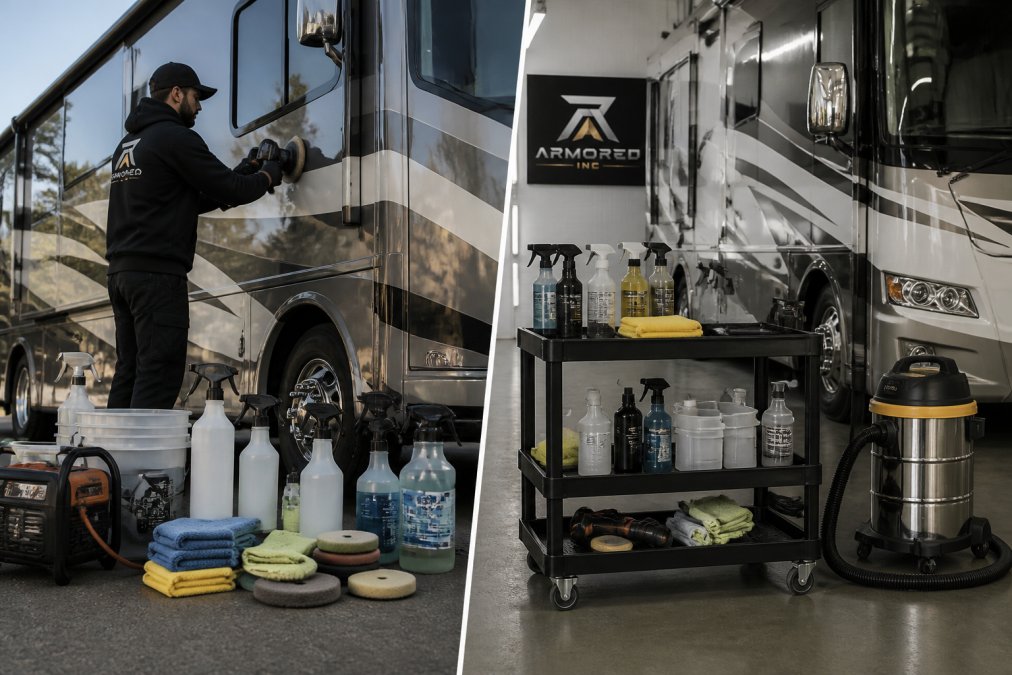
 comparison
Mobile RV Detailing vs Shop-Based Services: Which Wins?
Table of Contents
- Mobile RV Detailing vs Shop-Based Services: The Quick Comparison
- Cost Comparison and Hidden Fees
- Quality Control and Work Environment
- Convenience vs Professional Equipment Access
- RV Ceramic Coating in Barrie: Shop vs Mobile Application
- How Often Should I Detail My RV?
- RV-Specific Challenges and Barrie Logistics
- Frequently Asked Questions
Last Updated: September 16, 2026
Mobile RV Detailing vs Shop-Based Services: The Quick Comparison
Mobile RV detailing brings the wash, decontamination, and protection work to your driveway or storage site, while shop-based services move your rig into a controlled detailing bay. For most RV owners in Barrie, the honest answer is that neither wins outright: mobile suits maintenance washes and light interior work, and a shop wins for paint correction, ceramic coating, and anything that needs a dust-free, climate-controlled environment. This guide from Armored Inc. breaks down where each model earns its keep, what it costs you in hidden ways, and how to choose without wasting a weekend.
Here's the short version before the detail. Mobile RV detailing is a service model in which a self-contained unit travels to the customer's location with its own water supply, power, and detailing supplies to perform exterior wash, interior cleaning, and light protection on site. Shop-based detailing is a fixed facility with a dedicated detailing bay, controlled lighting, and heavy equipment that cannot realistically travel.
The trade-off is real, and it cuts both ways. Mobile wins on convenience and service accessibility. Shop wins on quality ceiling and consistency. The mistake most owners make is treating them as competitors when they actually solve different problems.
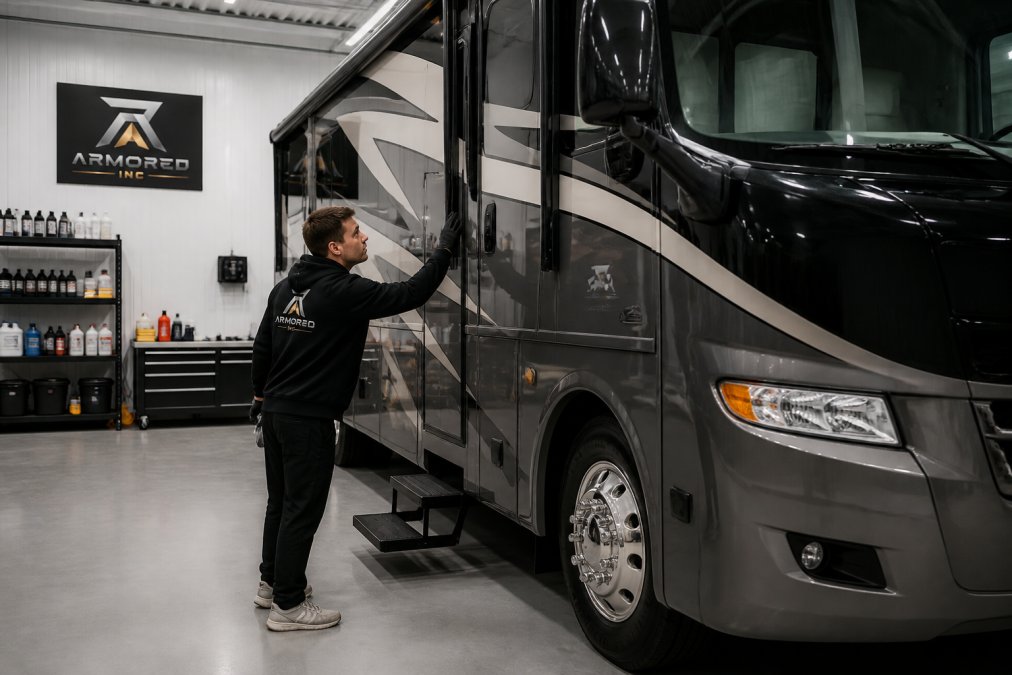
| Factor | Mobile Detailing | Shop-Based Detailing |
|---|---|---|
| Best for | Maintenance washes, light interior work | Paint correction, ceramic coating, PPF |
| Environment | Open air, weather dependent | Climate-controlled detailing bay |
| Equipment access | Portable, limited | Full, including high-pressure wash systems |
| Your time cost | Minimal | Transport both ways |
| Water and power | Unit brings its own | On-site hookups |
| Quality ceiling | Good for upkeep | Highest, especially for coatings |
Cost Comparison and Hidden Fees
Mobile detailing usually quotes lower headline numbers because the operator carries no lease on a detailing bay. That advantage shrinks once you account for what mobile units cannot do well, and for RVs, the gap between the quote and the final invoice is wider than it is for cars.
Here is what actually drives the price on a large-format vehicle in the Barrie and Simcoe area:
- Length-based pricing. RVs are billed by the foot. An RV that is 30 feet long and a 40-foot Class A are different jobs with different chemical volumes, water needs, and labor hours. Expect the quote to scale with length before any add-ons.
- Travel and setup fees. Mobile operators serving outlying storage lots around Barrie, Orillia, Innisfil, and Wasaga Beach often add a trip charge. A unit that has to haul its own water and generator fuel to a gravel lot with no hookups carries real cost that shows up on the invoice.
- Water and power sourcing. If your storage site has no spigot or outlet, the mobile unit brings its own supply. That is not free, and some operators bill it as a line item rather than folding it into the base rate.
- Size surcharges for roofs and undercarriage. Rubber roofs, slide-outs, awnings, and undercarriage salt spray are separate line items on most RV quotes. A standard exterior wash rarely includes them.
- Correction add-ons. Oxidation removal and gelcoat restoration are the single biggest variable on an older rig. They are quoted separately because the labor depends entirely on how far the gelcoat has degraded.
- Return trips. A mobile unit rained out mid-job in Barrie's shoulder seasons may need a second visit. Ask whether a weather-related return is billed or absorbed.
Shop-based work looks more expensive on the quote until you compare it against redoing a failed coating.
One cost most owners never ask about is liability. A mobile operator working in your driveway or at a storage lot carries different insurance than a brick-and-mortar facility with a dedicated bay. Before work starts, ask any provider, mobile or shop, whether they carry coverage for damage to a vehicle in their care, and get the answer in writing. On a high-value RV, that single question protects more money than any discount on the wash itself.
Quality Control and Work Environment
Dust is the enemy of every coating, and this is where the two models diverge hardest. A climate-controlled environment removes the airborne contamination that causes streaks, hazing, and premature coating failure. Open-air work cannot control wind, pollen, or nearby traffic.
Shop-based detailing gives you:
- Filtered air and stable temperature for coating cure
- Controlled lighting that exposes swirl marks and defects the eye misses outdoors
- A dedicated detailing bay where the vehicle sits undisturbed for the full cure window
- Access to heavy equipment, including water reclamation systems and high-pressure wash rigs
Convenience vs Professional Equipment Access
The convenience factor is not marketing fluff. Getting a large RV to a shop means fuel, a cleared schedule, and a return trip. Mobile service removes all three.
RV Ceramic Coating in Barrie: Shop vs Mobile Application
For RV ceramic coating in Barrie, a shop-based application is the better choice in almost every case. Ceramic coating needs a dust-free, temperature-stable space for the full cure window, and Ontario's weather does not cooperate with open-air coating work.
How Often Should I Detail My RV?
Most RV owners should plan a full detail once or twice a year, with exterior washes every four to eight weeks during the camping season. The real driver is not the calendar, it is exposure: how much sun, road spray, and tree sap the rig collects.
A workable schedule looks like this:
- Spring: Full exterior wash, decontamination, and oxidation check after winter storage.
- Every 4-8 weeks in season: Exterior wash to remove environmental contamination before it bonds.
- Fall: Deep cleaning, interior shampooing, and surface protection before storage.
- Annually: Inspect coatings and sealants; reapply as performance drops.
RV-Specific Challenges and Barrie Logistics
RVs break the rules that apply to cars, and that is why generic detailing advice fails them. The surface area alone is several times that of a pickup. Add rubber roofs, decals, gelcoat, window seals, and slide-out gaskets, and you have a set of materials that each need different products and techniques, and a height profile that most mobile units are not set up to reach safely.
- Height and reach. A Class A or fifth wheel can top 12 feet. Washing, rinsing, and coating the upper sidewalls and roof requires ladders, platforms, or extended poles. A mobile operator working solo from a driveway often cannot safely reach the full surface, which is why roof and upper-sidewall work is frequently excluded from mobile quotes.
- Water volume. A full exterior wash on a large RV can consume far more water than a car. A mobile unit hauling its own tank has to ration that supply, which pushes operators toward rinseless or waterless methods. Those methods work, but they demand more care per panel and more time.
- Power draw. Extractors, polishers, and steam units draw real amperage. A storage lot with no outlet means generator power, which limits how much equipment a mobile unit can run at once.
- Material variety. Gelcoat, vinyl decals, rubber roofing, and aluminum trim all react differently to the wrong chemical. A product that is safe on clearcoat can stain a decal or dry out a rubber roof.
Frequently Asked Questions
Does mobile RV detailing provide the same level of protection as a climate-controlled shop?
Mobile detailing can deliver excellent results for exterior washes, interior cleaning, and maintenance detailing. However, for high-end services like ceramic coating or paint protection film, a climate-controlled shop is better. Dust, pollen, and temperature swings outdoors can affect how coatings cure, potentially leading to uneven finish or reduced durability. If you want long-term surface protection, a shop-based application is usually the safer choice.
How does Ontario's climate affect the choice between mobile and shop-based RV detailing?
Ontario's freeze-thaw cycles, road salt, and summer UV exposure are tough on RVs. Mobile detailing works well for quick exterior washes and interior shampooing during mild weather. But for deep cleaning, oxidation removal, or applying a ceramic coating, a shop offers a controlled environment. That control matters when you need the coating to bond properly and last through winter. Many owners book a spring deep clean and fall protection service.
What are the logistical challenges of mobile RV detailing for large motorhomes?
Large motorhomes need significant space, water access, and power hookups for mobile detailing. Not every campsite or driveway has these. Mobile units also carry limited water and equipment, so a full restoration or heavy paint correction might not be feasible on-site. If your RV is over 30 feet, check that the mobile provider has the right gear and enough water before booking.
Is ceramic coating for RVs better applied in a shop or on-site?
Ceramic coating for RVs is best applied in a shop. The application requires a dust-free, temperature-stable environment for proper curing. Mobile setups can work for small touch-ups, but full RV ceramic coating in Barrie is typically done in a detailing bay where the technician controls lighting, humidity, and cleanliness. That control helps the coating bond evenly and deliver the hydrophobic, UV-resistant finish you're paying for.
How often should I detail my RV to protect it from Barrie's weather?
For RVs in Barrie, a full exterior wash and interior clean every 4-6 weeks during camping season is a good baseline. Add a deep cleaning and wax or ceramic boost in spring and fall. If you drive on salted roads or store outside, maintenance detailing every 8-12 weeks in winter helps prevent rust and oxidation. Always check for black streaks and sealant breakdown after heavy rain.