 comparison
Ceramic Coating: Shine, Hydrophobicity & UV Protection
Table of Contents
- What Ceramic Coating Actually Does for Paint Integrity and Shine
- How Long Does Ceramic Coating Last on Cars in Ontario?
- Paint Protection Film vs Ceramic Coating: Which Protects What
- Ceramic Coating Maintenance Tips Barrie Drivers Need
- Ceramic Coating Options and Pricing Breakdown
- Why Professional Application Beats DIY Spray Coatings
- Conclusion
- Frequently Asked Questions
Last Updated: September 16, 2026
What Ceramic Coating Actually Does for Paint Integrity and Shine
Ceramic coating is a liquid polymer applied to a vehicle's exterior that cures into a semi-permanent protective layer, bonding at a molecular level to create a hydrophobic barrier against environmental contaminants. At Armored Inc. in Barrie, Ontario, we apply professional-grade coatings that do two jobs at once: they shield the clear coat from chemical and UV damage, and they deliver shine and hydrophobicity a traditional wax cannot match over time.
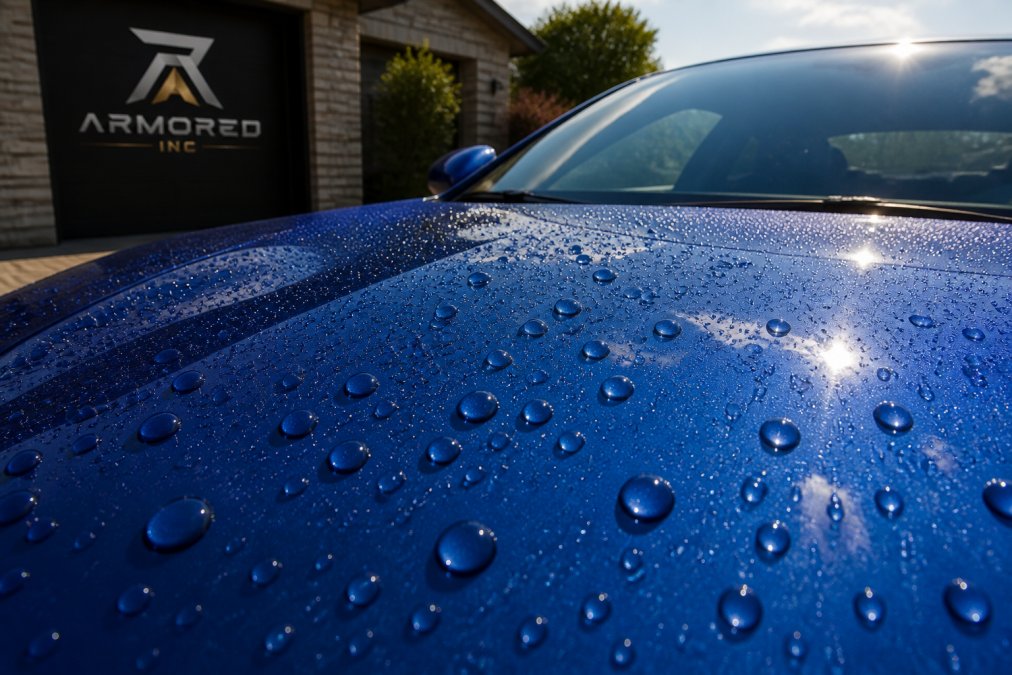
How the Hydrophobic Barrier Forms
The coating's active ingredient is a silicon-based polymer, typically silicon dioxide (SiO2). During curing, these molecules cross-link and bond to the paint's clear coat, creating a surface with very low surface tension.
UV Radiation, Oxidation, and Gloss Retention
UV radiation is the quiet killer of automotive paint. Prolonged sun exposure breaks down the clear coat's polymer matrix, causing oxidation, fading, and the chalky look of older, unprotected vehicles.
How Long Does Ceramic Coating Last on Cars in Ontario?
Professional ceramic coatings typically last two to five years on cars, depending on product tier, application quality, and maintenance. Entry-level coatings sit at the lower end; multi-layer systems reach the upper end.
What Shortens or Extends Coating Life
The biggest lifespan killer is automatic car washes with harsh brushes and aggressive detergents. These strip the coating's hydrophobic top layer faster than anything else.
- Extends life: pH-neutral hand washing, periodic decontamination, garage parking
- Shortens life: brush car washes, acidic bird droppings left sitting, abrasive polishing
- Neutral: rain exposure, normal highway driving
Paint Protection Film vs Ceramic Coating: Which Protects What
Paint protection film (PPF) and ceramic coating protect against different threats, and they are not competitors. PPF is a thick urethane film that absorbs physical impacts: rock chips, scratches, and road debris. Ceramic coating is a thin chemical layer that repels water, contaminants, and UV rays.
| Feature | Paint Protection Film | Ceramic Coating |
|---|---|---|
| Primary protection | Physical impact, chips, scratches | Chemical, UV, hydrophobic |
| Thickness | Thick urethane film | Microscopic polymer layer |
| Lifespan | 5-10 years | 2-5 years |
| Best for | High-impact zones, matte paint | Whole-vehicle gloss and UV defense |
| Surface shine | Minimal change | Significant gloss enhancement |
Layering Coatings and PPF Compatibility
Yes, you can layer them, and the correct order is PPF first, then ceramic coating on top. The coating protects the film itself, adding hydrophobicity and UV stability to the PPF surface.
Ceramic Coating Maintenance Tips Barrie Drivers Need
Maintenance is where coated vehicles either shine for years or fade early. A coated car needs less work than an uncoated one, not more, and in Barrie, the right routine also saves real money.
The Barrie Winter Problem, Specifically
Barrie sits in one of Ontario's heaviest snowbelt corridors. From roughly November through March, the City of Barrie and the Ontario Ministry of Transportation deploy rock salt (sodium chloride) and, on Highway 400 and Highway 26, liquid brine pre-treatment. Brine is the more aggressive of the two: sprayed before a storm, it sticks to paint and glass and dries into a fine white film that bonds to unprotected surfaces.
The Realistic Maintenance Schedule for a Coated Car in Barrie
- Every two to three weeks (year-round): pH-neutral hand wash using the two-bucket method. Skip brush automatic washes, they are the single fastest way to strip a coating's top layer.
- After every significant snowfall or brine event: A touchless rinse if you can't do a full wash. This removes the bulk of the salt film before it cures onto the surface.
- Early spring (late March to mid-April): A full decontamination wash, iron remover, tar remover, then a pH-neutral wash, to strip the accumulated winter film. This is the single most important maintenance step for a Barrie-coated vehicle.
- Twice per year (spring and fall): Apply a ceramic sealant booster to refresh the hydrophobic layer and extend the coating's service life.
- Immediately, always: Remove bird droppings, bug splatter, and tree sap. Their acidity etches even coated surfaces if left for days, and Barrie's summer tree canopy along streets like Dunlop and Collier makes sap a real risk for parked cars.
The Cost-Benefit Math Most Guides Ignore
An uncoated daily driver in Barrie needs a wash every 7 to 10 days through winter to prevent salt damage, roughly 20 to 25 washes between November and April. At a typical Barrie touchless or hand-wash price of $15 to $25 CAD, that's $300 to $625 CAD per winter just on washing.
Ceramic Coating Options and Pricing Breakdown
Pricing for professional ceramic coating depends on vehicle size, paint condition, coating tier, and whether paint correction is included. Armored Inc. does not publish fixed prices because a two-door sports car and a full-size SUV require very different prep and material volumes. Contact us for a quote tailored to your vehicle.
Single-Layer vs. Multi-Layer: What You're Actually Buying
A single-layer professional coating is one application of the SiO2 polymer, cured into one cross-linked film. It delivers the expected hydrophobic and UV protection, but the film is thin, fractions of a micron, and its durability ceiling sits at the lower end of the professional range.
- Resist chemical etching (bird droppings, bug splatter, industrial fallout) longer
- Maintain hydrophobic contact angles, the beading behavior, for more of the coating's rated life
- Provide more sacrificial material, so a light polish later in the coating's life removes less of the protective layer
How Ceramic Coating Stacks Over Paint Protection Film
This is the technical gap most pricing guides skip. PPF and ceramic coating are not competitors, they protect against different threats, and the correct order is always PPF first, then ceramic coating on top.
When you stack them:
- The PPF absorbs physical impacts (rock chips, scratches, road debris) that would otherwise reach the clear coat.
- The ceramic coating on top adds hydrophobicity, UV stability, and chemical resistance to the film itself, which extends the film's usable life and makes it easier to clean.
- You get one combined system with a longer effective service life than either product alone.
The Tier Comparison
| Option | Durability | Best For |
|---|---|---|
| DIY spray coating | Weeks to months | Between professional services |
| Entry professional coating (single layer) | 2-3 years | Daily drivers on a budget |
| Multi-layer professional system | 4-5 years | High-value and enthusiast vehicles |
| PPF + ceramic combination | 5-10 years (film), coating refreshed periodically | Full protection on new vehicles |
Consumer spray products like Turtle Wax Hybrid Solutions run roughly $20 to $30 CAD and work as a stopgap, but they are not a substitute for a professionally applied coating.
What Actually Drives the Price
Four variables move the quote more than anything else:
- Paint condition. A vehicle with heavy swirl marks, oxidation, or contamination needs more paint correction hours before coating. Correction is often the largest line item.
- Vehicle size and panel complexity. A full-size SUV or a vehicle with complex curves takes more material and more application time than a compact sedan.
- Coating tier. Single-layer vs. multi-layer, and the rated durability of the product itself.
- Add-ons. PPF on high-impact zones, glass coating, wheel and trim coating, and interior protection all change the total.
Because of those variables, the honest answer to "how much does ceramic coating cost in Barrie?" is a range, not a number, any quote given without seeing the vehicle is a guess. A professional assessment takes minutes and produces a quote you can compare against other options.
Why Professional Application Beats DIY Spray Coatings
At Armored Inc., we handle paint correction, coating application, and PPF in one facility, which means the layering order is right the first time. We also offer mobile service and valet options for owners who can't leave their vehicle for a full day.
Conclusion
Choosing between protection that preserves your investment and shine that turns heads isn't actually a choice. A properly applied ceramic coating does both, and the difference between a coating that lasts two years and one that lasts five comes down to preparation, product grade, and maintenance habits.
Frequently Asked Questions
Does ceramic coating actually protect my car's paint from Barrie's harsh winters?
It helps, but it is not a substitute for PPF. A ceramic coating forms a hydrophobic barrier that repels water, road salt spray and grime, which reduces how long contaminants sit on the clear coat. The coating itself is thin and will not stop rock chips. For Barrie winters, many owners pair a coating with paint protection film on high-impact areas like the front bumper and hood.
What is the difference between surface shine and paint integrity?
Surface shine is the visible gloss and water beading you notice right after application. Paint integrity is the underlying condition of the clear coat: whether it is oxidizing, fading from UV radiation, or collecting bonded contaminants. A ceramic coating contributes to both, but shine is cosmetic while integrity affects resale value and how long the paint lasts.
Is UV protection a standard feature of all ceramic coatings?
No. UV absorbers and thermal stability vary by formulation. Consumer spray products often list UV protection but degrade within weeks. Professional coatings are engineered to resist UV-induced fading and oxidation over a longer service life. Ask your installer which specific product is being applied and what its rated durability is.
How long does a professional ceramic coating last in Ontario's climate?
Most professional-grade coatings are rated for multiple years, but actual lifespan depends on preparation, product tier and maintenance. Ontario's road salt, freeze-thaw cycles and summer UV exposure all stress the coating. Annual inspections and proper washing extend service life noticeably. Armored Inc. can advise on realistic expectations for your vehicle and driving habits.