 ultimate-guide
Marine Ceramic Coating for Salt Water: 2026 Guide
Table of Contents
- What Marine Ceramic Coating Does in a Saltwater Environment
- Benefits of Boat Gelcoat Ceramic Coating
- Marine Ceramic Coating Application Process Step by Step
- How Long Does Marine Ceramic Coating Last in Salt Water
- Maintenance and Aftercare to Maximize Coating Durability
- DIY vs. Professional Application: Cost-Benefit Analysis
- Environmental Impact, Marine Safety, and Removal Protocols
- Conclusion
Last Updated: August 17, 2026
What Marine Ceramic Coating Does in a Saltwater Environment
Marine ceramic coating is a liquid polymer, typically SiO2-based, that bonds chemically to a vessel's gel coat or topcoat to form a semi-permanent protective layer resisting saltwater corrosion, UV degradation, and biological fouling. Unlike traditional wax or sealant, it integrates with the substrate, creating a sacrificial layer that protects your hull.
Saltwater is hostile to fiberglass and painted surfaces. Salt spray deposits crystallize in micro-scratches, accelerating oxidation and gel coat breakdown. UV radiation bleaches pigment and weakens the substrate beneath. A quality marine ceramic coating addresses both threats simultaneously, eliminating seasonal re-waxing cycles.
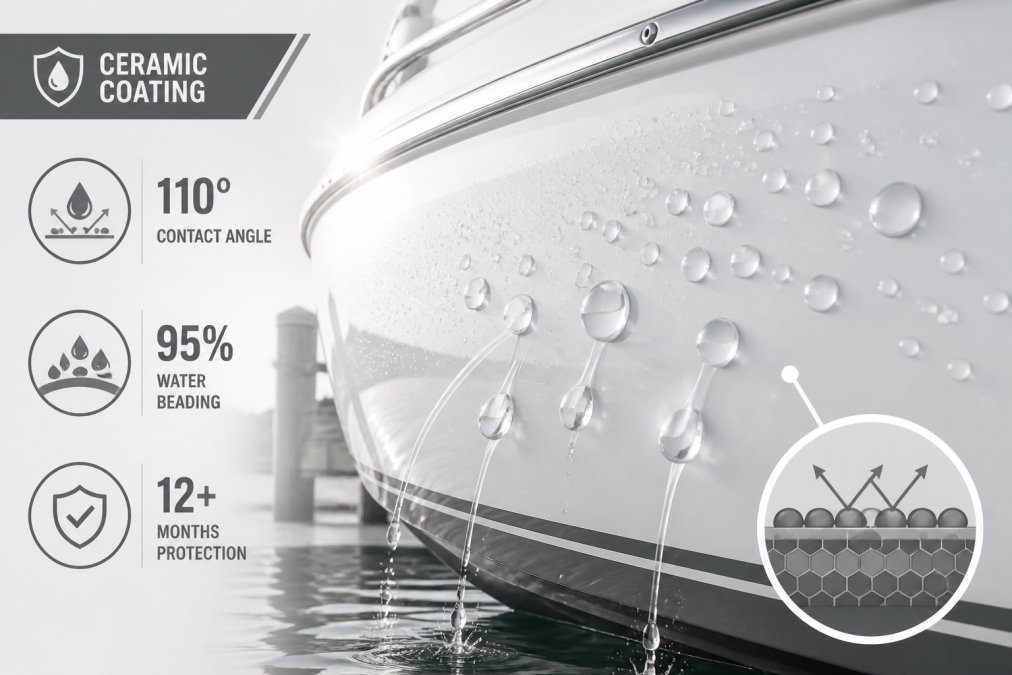
The core mechanism is hydrophobicity. The cured nano-coating creates surface energy so low that water, salt, and contaminants bead up and roll off rather than bonding to the hull. This beading effect actively reduces the time salt sits in contact with your gel coat, the primary driver of long-term corrosion damage in saltwater environments.
Benefits of Boat Gelcoat Ceramic Coating
The benefits extend well beyond a glossy finish, though the gloss enhancement alone is noticeable at the dock.
Salt Spray Corrosion and UV Degradation Resistance
Salt spray corrosion is the biggest threat to hull integrity over a vessel's lifespan. Salt deposits are hygroscopic, attracting and holding moisture, keeping the surface wet even after the boat is out of the water. Over seasons, this leads to oxidation, micro-marring, and deeper structural degradation.
A marine ceramic coating interposes a chemically resistant nano-coating between saltwater and your gel coat. The SiO2 matrix is largely inert to salt, meaning it doesn't react or break down on contact. UV degradation is addressed through the same mechanism: the coating absorbs and disperses UV radiation that would otherwise bleach the gel coat beneath. According to Transport Canada's boating safety and vessel maintenance guidance, maintaining hull integrity is a core component of vessel seaworthiness.
Hydrophobic Properties and Hull Fouling Reduction
The hydrophobic properties of a cured ceramic coating separate it from every other protection product. Water contact angles on a properly coated hull are high enough that droplets form and roll off, taking salt and contaminants with them.
Hull fouling, the accumulation of algae, barnacles, and biological matter below the waterline, is partially mitigated by the reduced surface adhesion a ceramic coating provides. Algae and salt buildup depend on surface roughness and energy to establish a foothold. A smooth, hydrophobic nano-coating denies them both. The coating is not a replacement for antifouling paint below the waterline but meaningfully reduces fouling rates on the waterline and above.
Gloss Enhancement and Long-Term Oxidation Prevention
Oxidation is the enemy of gel coat aesthetics. Left unprotected, a white hull will chalk and yellow within a few seasons. A marine ceramic coating seals the gel coat surface, preventing the oxygen and UV exposure that drive oxidation. The result is a hull that retains its original color depth and gloss significantly longer than an uncoated or waxed vessel.
A smoother, glossier surface also produces less hydrodynamic drag, which many owners report translates to marginally better fuel efficiency at planing speeds.
Marine Ceramic Coating Application Process Step by Step
The marine ceramic coating application process is where most DIY attempts fail and where professional application consistently outperforms. Here is the complete process:
- Wash the hull thoroughly with a marine-grade cleaner to remove all loose salt, dirt, and biological matter.
- Degrease with a panel wipe or IPA solution to remove wax, silicone, and oil residues.
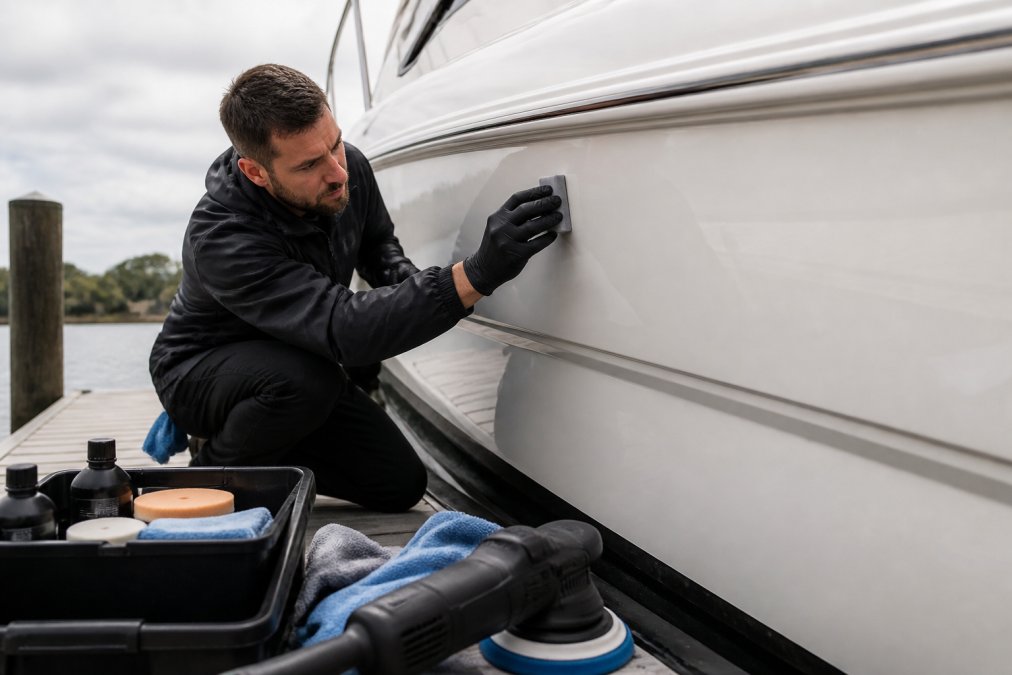
- Paint correction and polishing to address oxidation, micro-marring, and swirl marks using a machine polisher. The coating locks in whatever surface condition it finds.
- Clay bar treatment (if needed) on heavily contaminated surfaces to remove embedded environmental contaminants.
- Final wipe-down with one last degreasing pass immediately before application.
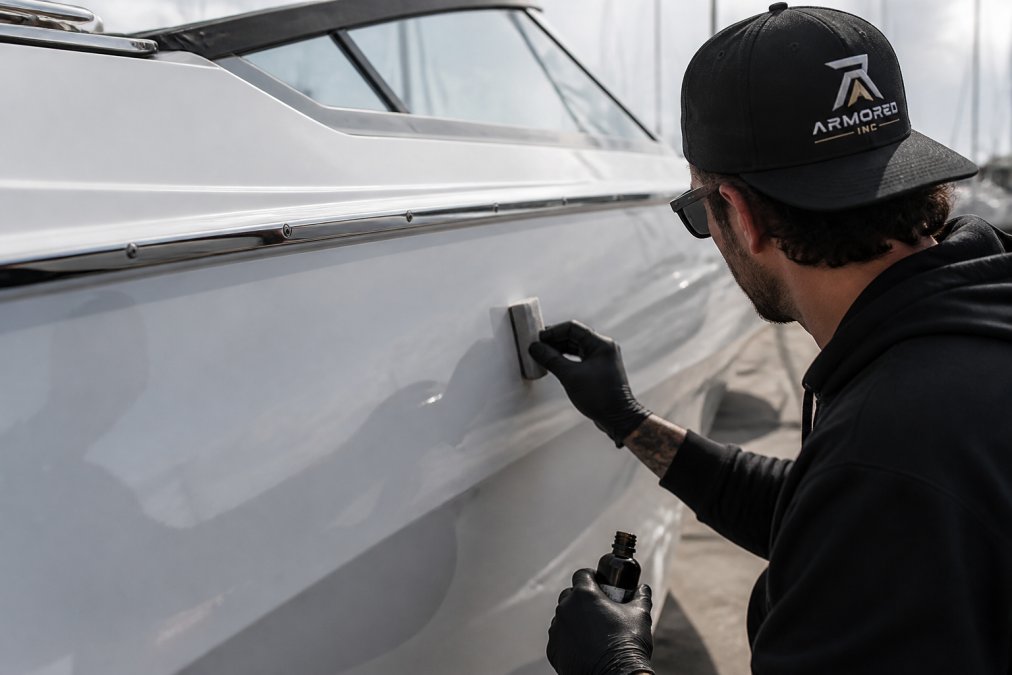
- Apply the ceramic coating in small sections using a foam applicator pad in overlapping passes. Avoid direct sunlight and high humidity.
- Flash time and leveling per the product's specified time, then level with a clean microfibre cloth before it hardens.
- Curing time: Most marine ceramic coatings require 24-48 hours before water contact, with full cure taking 7-14 days depending on temperature and humidity.
Surface Preparation: Degreasing, Polishing, and Paint Correction
Surface preparation is the most time-consuming and consequential step. Paint correction, removing oxidation, swirl marks, and surface scratches through buffing and polishing, determines the final result quality. The ceramic coating amplifies the surface beneath it; a well-corrected hull looks exceptional once coated, while a poorly prepared one looks mediocre.
Degrease twice: once before polishing to prevent compound contamination, and once after to remove buffing residue. Use a lint-free applicator and work in a shaded area.
Applying the Coating and Curing Time Requirements
Work in sections no larger than 0.5 square metres at a time. Apply the coating in a crosshatch pattern, horizontal passes followed by vertical, to ensure even coverage and avoid missed spots.
Curing time is non-negotiable. Exposing a partially cured coating to water, salt spray, or direct sunlight before it has fully hardened compromises the chemical bond and reduces durability. In cooler Ontario temperatures, extend the recommended cure time by at least 20-30%.
Troubleshooting Common Application Errors
High spots form when the coating is allowed to cure too long before leveling. If caught early, a fresh applicator with a small amount of coating product can soften the high spot for leveling. If fully cured, high spots require machine polishing to remove.
Streaking typically results from uneven applicator pressure or insufficient product. Work with a consistently loaded applicator and maintain even pressure.
Adhesion failure, where the coating peels or separates from the gel coat, almost always traces back to inadequate degreasing.
How Long Does Marine Ceramic Coating Last in Salt Water
Marine ceramic coating typically lasts between two and five years in a saltwater environment, depending on coating quality, application quality, UV exposure, and maintenance consistency. Professional-grade products applied by trained technicians consistently reach the upper end of that range.
Saltwater is more demanding than freshwater. Salt spray is abrasive at a microscopic level, and the combination of salt, UV radiation, and biological exposure degrades the SiO2 matrix faster than freshwater conditions. Vessels that are trailered and stored out of the water between uses will see longer coating life than those remaining in the water year-round.
Maintenance practices have the largest effect on longevity after initial application quality. A coating receiving regular maintenance washes and periodic SiO2 topper applications will outlast a neglected one considerably, regardless of initial product quality.
As documented in the National Research Council Canada's corrosion and materials research publications, marine-grade protective coatings in high-salinity environments require periodic reactivation or supplementation to maintain their protective properties over multi-year periods.
Maintenance and Aftercare to Maximize Coating Durability
Maintaining a ceramic-coated hull is straightforward but requires consistency. The coating does not eliminate maintenance; it makes maintenance faster and more effective.
Maintenance checklist for a ceramic-coated vessel:
- Rinse the hull with fresh water after every saltwater outing to remove salt deposits before they crystallize
- Perform a maintenance wash with pH-neutral marine soap every 4-6 weeks during the boating season
- Avoid pressure washers above 1,200 PSI directed at close range
- Apply a spray SiO2 topper or booster every 3-4 months to replenish the hydrophobic layer
- Inspect the hull for micro-marring or dull patches annually
- Avoid abrasive cleaning pads or brushes; use microfibre only
When water stops forming tight, round beads and begins sheeting across the surface, the hydrophobic layer is depleted and a topper application is due.
DIY vs. Professional Application: Cost-Benefit Analysis
DIY marine ceramic coating application is possible, but the margin for error is significant and the consequences of getting it wrong are expensive.
| Factor | DIY Application | Professional Application |
|---|---|---|
| Surface preparation quality | Variable; depends on skill and equipment | Consistent; machine-corrected finish |
| Application environment | Uncontrolled; weather-dependent | Controlled; shaded, temperature-managed |
| Product access | Consumer-grade coatings | Professional-grade, higher-durability products |
| Warranty | None | Typically included |
| Risk of high spots / streaking | High for first-time applicators | Low |
| Time investment | 1-3 days depending on vessel size | Handled by technician |
| Long-term coating life | 1-2 years typical | 3-5 years typical |
For a small runabout with a simple hull, an experienced detailer can achieve good results with a consumer-grade product. For a larger vessel with complex hull geometry, significant oxidation, or gel coat requiring paint correction, professional application is more economical when you factor in the cost of doing it twice after a failed DIY attempt.
Armored Inc. offers professional marine ceramic coating services. For boat owners who want the full benefit of a professional-grade coating without the risk of application errors, contact us for a vessel assessment and quote.
Environmental Impact, Marine Safety, and Removal Protocols
Environmental responsibility is a genuine consideration for marine coating products. Most professional-grade ceramic coatings, once fully cured, are chemically stable and do not leach harmful compounds into the water column. The SiO2 matrix is inert in its cured state. The environmental risk window is during application and initial cure, when uncured coating product must be kept away from water.
According to Environment and Climate Change Canada's guidance on marine pollutants and vessel maintenance, vessel operators are responsible for preventing any coating or chemical product from entering waterways during application or maintenance. Apply ceramic coatings in a controlled environment, on a trailer, in a covered boatyard, or on a dry dock, never over open water.
Removal and reapplication protocols: Ceramic coatings do not simply wear off cleanly. When a coating reaches the end of its service life, it typically degrades unevenly. The correct protocol is to machine polish the hull with a cutting compound to remove the remaining coating, assess the gel coat beneath for oxidation or damage, perform any necessary paint correction, degrease, and apply a fresh coating.
Attempting to apply a new marine ceramic coating over an old, degraded one is one of the most common and costly mistakes vessel owners make. The new coating cannot bond properly to the old SiO2 matrix, and the result fails faster than either coating would have independently.
Saltwater is relentless, and hull protection that can't keep pace costs more in the long run than doing it right the first time. Armored Inc. specializes in professional marine ceramic coating application for vessels across Ontario. Our technicians handle surface preparation, paint correction, and application in controlled environments that DIY approaches simply can't replicate. Contact Armored Inc. to protect your vessel before the next season puts it to the test.
Frequently Asked Questions
Can I apply ceramic coating to gelcoat?
Yes, ceramic coating bonds well to gelcoat when the substrate is properly prepared. The surface must be cleaned, degreased, and polished to remove oxidation and micro-marring before application. Skipping paint correction leaves contaminants trapped under the nano-coating, which reduces adhesion and shortens durability. A marine-grade SiO2 sealant applied to a clean, polished gelcoat surface will deliver the full hydrophobic and UV protection benefits the coating is designed to provide.
How long does marine ceramic coating last in salt water?
A professionally applied marine ceramic coating typically lasts two to five years in a saltwater environment, depending on UV exposure, maintenance frequency, and coating grade. Consumer-grade products applied at home generally last one to two seasons before the hydrophobic properties diminish noticeably. Regular maintenance washes and annual inspections help preserve the sacrificial layer. Boats stored in the water year-round face more aggressive salt buildup and UV degradation, so annual top-ups are worth scheduling.
What is the downside of ceramic coating on a boat?
Marine ceramic coating does not prevent all damage. It resists chemical contaminants, UV degradation, and salt spray corrosion, but it will not stop deep scratches, impact damage, or hull fouling from heavy algae accumulation below the waterline. Application errors like high humidity, inadequate degreasing, or incorrect curing time can cause hazing or streaking. Professional application reduces these risks significantly. The upfront cost is also higher than traditional wax or sealant options, though the longer service life generally offsets that over time.
How does ceramic coating protect against salt water corrosion?
Ceramic coating forms a hardened, hydrophobic topcoat over the boat's substrate that physically blocks salt spray and moisture from reaching the fiberglass or gel coat beneath. The SiO2 nano-coating fills microscopic surface pores, leaving environmental contaminants and salt buildup with nowhere to bond. Water sheets off rather than sitting on the surface, which reduces the prolonged contact time that drives oxidation and corrosion. This chemical resistance is the core reason marine ceramic coatings outperform conventional wax in saltwater environments.
Is a marine ceramic coating the same product used on cars?
Marine-grade ceramic coatings are formulated specifically for the harsher conditions boats face: prolonged UV exposure, constant moisture, salt spray corrosion, and hull fouling from algae accumulation. Automotive ceramic coatings share similar SiO2 chemistry but are engineered for painted metal and road-use conditions. Using an automotive product on a boat hull is not recommended because it may not bond correctly to gelcoat and will likely degrade faster in a saltwater environment. Always choose a product rated for marine use.
How do I maintain a ceramic-coated boat hull?
Rinse the hull with fresh water after every saltwater outing to remove salt buildup before it bonds to the coating. Use a pH-neutral maintenance wash every four to six weeks rather than harsh detergents that strip the hydrophobic layer. Avoid abrasive pads or buffing compounds during routine cleaning, as these cause micro-marring and wear through the sacrificial layer prematurely. Inspect the coating annually and arrange a professional top-up or reapplication if water stops beading consistently across the hull surface.
This article was written using GrandRanker